HN seems uniquely good at philosophical questions, so I was hoping to get your thoughts. I thought about framing the question more, but honestly, "What's the point of life?" is the refrain that I keep coming back to. It would be nice to escape it.
It's up to you to decide what it is that matters to you but if you're looking for some universal direction then that will just lead to frustration.
If you're lucky and you have the resources then you're in a position to choose which I understand can feel overwhelming. I would just encourage you to consider the possibility that you've been given a gift and you should cherish it.
Allan Watts
But seriously, to understand why you’d never get true objective answer you need to realize something.
The question itself contains 2 critical assumptions:
1. There’s objective cause-effect relationship embedded in the nature of reality (and therefore life).
Imagine there’s no causality and all you see is just a correlation of events of different levels of certainty.
Would this question make sense at all?
And causality is nothing more than a model of the world in our human minds. A very good and practical one, but just a model.
How do you expect to get good answer to a question outside of the model scope, but which make sense only within the model.
2. We as humans somehow can know or impose some ultimate goal for the life itself as though we were the ones who invented it in the lab.
While in reality we’re just observers and a tiny piece of life we know of.
We have no real control of the process itself, and we’ll never know how it really started unless someone external will show us.
But then still we will have no reference point to know for sure if this someone is not just another form of the same life trying to fool us. Etc.
So anyway, this question (in its ultimate form) is deeply meaningful, because it implies the answer which lies outside of the system making the question possible in the first place.
Answer “there’s no point” is also wrong. For the same reasons. May be there is. May be someone created it on purpose, but again we will never know this for sure, at least with existing methods of “knowing”
But luckily as humans, we have developed brains so big that we realized that isn't the only purpose of life. For humans, the purpose of life is:
Pleasure.
Doing whatever it takes to make yourself happy, hopefully not at the expense of others. Some people never achieve happiness, some achieve it early with few resources. Some people achieve it over and over as they age and different things make them happy.
In my 20s, building great software and doing well at work made me happy. In my 30s, that continued to make me happy, but since I had some money, adding great meals and fun travel made me happy. In my 40s it's spending time with my kids that is what primarily makes me happy. Who knows what it will be in my 50s and beyond.
You have to find what makes you happy within the resources you have.
Said better than I could ever try.
Then I suffered a disability and came upon the realization similar to Helen Macdonalds, in H is for Hawk:
"There is a time in life when you expect the world to be always full of new things. And then comes a day when you realise that is not how it will be at all.
You see that life will become a thing made of holes. Absences. Losses. Things that were there are no longer. And you realise, too, that you have to grow around and between the gaps, [...]"
In an effort to adapt to this, I clung to stoicist philosophy. Life is to be weathered, through the development of virtues, and above all else--realizing what you have control over, and what you do not.
Upon becoming homeless, I realized this wise and practical branch of philosophy had not exactly delivered on it's promises. You cannot be destitute, sick, and isolated, and still manage to be happy, despite Stoicist claims to the contrary. This branch of philosophy oddly seems entitled to me now--little wonder it grew popular with intelligentsia, emperors, and now tech CEOs. I grew to far prefer its philosophical progenitor, Cynicism.
For this phase of my life, Albert Camus resonates and brings comfort. Life is absurd. The challenge is not to unravel or create meaning for life, but to image personal happiness in a stochastic world that defies explanation (though some such explanation may indeed exist, it is certainly absurd to human minds. I envy the dismissive confidence of those that proclaim "no point!")
This philosophy has served me far better than the others, though who knows what will come in the twilight of my life. Life is strange, fellow travelers.
Through more than one circumstance of birth I have been forced on the proverbial path less trodden and I can't say it has been amazingly fulfilling. Of course, one can look at another and suspect how wonderful or terrible their life is, but that is all you have, suspicion. Friends who are married, friends who have children, some ... seem satisfied?
And then things go on and you become closer to the end of life than the start of it, more doors are closed than are open, and you wonder what -- if anything -- lies between here and the final trainstop, and if it is indeed worthwhile. You get a distant Peggy Lee "Is That All There Is?" detachment. The philosophers will tell you to assign some kind of arbitrary value and meaning and it is a bit like being thrown off of an infinite cliff and being told that you should assign the bottom of your soles as "h = 0" in that it lacks satisfaction as an answer.
I haven't anything to offer but a nod of recognition.
There are many questions we aren't really close to answering and our knowledge of this universe is very incomplete. Ultimately if we are able to develop a complete understanding of this universe down to the very origins of existence with no loose ends we can answer the question why we exist. So that's the goal. Help humanity answer this question. It might not be answered in your lifetime but the purpose of existence is not about your life. It's a longer term story that runs over countless generations eventually leading to the answer you ask.
Life doesn't have a point. All life is different and the only common purpose is to make more of itself and keep going. That isn't a "point" so much as the only behavior that can possibly be self-propagating, in the sense that any form of life that didn't prioritize it would be out-competed and driven extinct by a different form of life that did.
There is no reason that should define you, though. We're a grand cosmic accident. Make of it what you will. I try to find meaning where I can, but if you're looking for grand revelatory purpose, you probably need to find religion, which unfortunately requires a mindset you might not have. I know I don't. I'll be gone soon and it won't make any difference at that point whether I ever existed at all from my no longer continuing first-person perspective. I hope it will matter that I existed to others who outlive me, but they'll soon be gone, too. This universe will end and all information ever created will be lost forever.
Nonetheless, right now, I'm getting a chance to exist, and I'm glad for it. I will be there forever, a tiny indistinguishable speck in the four-dimensional firmament, but there, and right now, from my perspective, I'm here and it's better than not being here.
And He also said: "For behold, this is my work and my glory—to bring to pass the immortality and eternal life of man." (https://abn.churchofjesuschrist.org/study/scriptures/pgp/mos... verse 39.)
Consider that: God's purpose is for our eternal benefit, and the purpose of life is joy.
I have learned for myself that the above is true, that mercy and justice are real, and our choices matter, and life, while legitimately full of hard things, does have purpose and can lead to peace, and eternal life. This mortality is not the beginning or the end, for sure.
There is so much more, and I have found (amid divorce/remarriage, long-term health issues, mistakes, sweet grandchildren now, and a variety of learning experiences) that it really, really helps, and life is good.
Edit: minor wording clarifications.
Some people find this idea really bleak, but there is also a form of liberation in it. You have some time given to you, and at the end of it your atoms will disperse and perhaps become someone else, or a cloud, or whatever. In the meantime, you can do things that make sense to you. Some people dedicate themselves to work, a musical instrument or family. These are all choices you can make, or any combination thereof. Pick one that makes you happy or satisfied in some way.
So no, I don't think there is any "point" to life, certainly not some point that is the same for everyone. But life not having a point does not mean it can't be enjoyable.
However, there’s also no rational reason why this question should bother you - that is an emotion.
In a normal hormonally balanced brain, endorphins encourage you not to dwell on such questions emotionally.
If you find yourself consumed by it, then you might want to look into why you are feeling that way. It’s possible that you are suffering from mild depression.
Just as "there's no point" is of no consolation in this situation, it should be of no detriment to your experience of happiness, beauty, love, fulfilment, etc.
People who decide that "there's no point" (for some usually ill-defined, abstract interpretation of that phrase), and conclude that this has some actual bearing on their lives, are deluded in a way that leads to nothing good. (I say this having been such a person.)
The more I think about people's search for "meaning", the more it seems to mean simply a coherent satisfying story.
"Life is trying things to see if they work."
Away from that, on one dimension you then have the classic supporting-actor role. You baked the bread or brewed the beer that sustained the next Einstein or Estefan. Good job! On the same axis but a bit further removed: maybe you paid the taxes that paid Einstein2's research grant, or put Estefan2 through music school. Again, good job! Taxes are a good if slightly basic way of supporting your local society.
A different and orthogonal dimension is kids. You might directly raise Einstein3, or you might raise the guy who runs Einstein4's pub. At the very least your kids will be paying taxes to support the single mother of Estefan5. You can also support the people who raise kids. You're the solid gal who grows the potatoes eaten by the teachers who taught Estefan6 how to write.
You've got to play a part in society though. Some people withdraw from society and it's the most abysmal thing you could do as a member of a social, cultural, and technological species. I'm looking at you, preppers. Get back over here – back on the the grid as they would never say – and do something useful for the rest of us. Bake some bread! Think of the children!
/micromanager rant
If there is one, it can come from an external source or from our own subjective self.
The former is what traditional religions claim, and most settle on some form of "praising the Creator" as the point of life.
The latter is probably best captured by existentialism. I would recommend Camus.
If there is not one, then that is nihilism. I would recommend Nietzsche.
I think the choice is between God and Nietzsche. I picked God.
I don't think there is a point to life. Reminds me of this book: https://www.amazon.com/Spiritual-Warfare-Three-Enlightenment...
It’s “easy” to descend into nihilism and the view that human existence is ultimately devoid of meaning. It’s more challenging (and rewarding, in my opinion) to accept the struggle of life as the point of life itself, to keep moving even when it seems like it’s fruitless.
Basically, I stay alive out of spite against nihilism and the impulse that says to give up.
Living also leaves open the opportunity that things will get better and that some meaning will eventually reveal itself. Nihilism and suicide (physical or philosophical) lead to nothingness and annihilation.
https://www.jw.org/en/bible-teachings/questions/meaning-of-l...
This also means no one else can tell what is the meaning of YOUR life, you have to pick it yourself, or not, also your choice.
One of the things I love doing is making video games (with a lot of help from my son!). But my goal when deciding what game to make isn't to be "successful" by making a lot of money or using it as a springboard to start a business or whatever. If that were the goal I would end up with a completely different game that I probably wouldn’t enjoy making as I would always be consumed by the fear of making something that appeals to as many people as possible in order to maximise profit. It's not about making something I can sell. It's about sharing something I loved making.
I've recently just finished my first original game and it genuinely won't matter to me one bit if no one plays it except me and my son (and hopefully the rest of my family!). I had so much fun making it that I’m actually a bit sad that it’s over! That is the definition of success for me - finding a project that I truly enjoyed working on every day for a year and a half for no other reason that I wanted (needed?) it to exist. That doesn't mean I don't want to make money from the game though if possible! That would be great! But the happiness I get from trying to sell it is completely different from the happiness I got from making it. I'm in the process of trying to market the game now and trying to dive deep into it, looking for ways to enjoy each part of the process. But if I try for a while and can’t find a way to enjoy it, I will just stop and move onto the next game.
So in a nutshell, if I genuinely try to focus on doing the things I love every day (and I have many, many things to choose from - video games is just one example), then I am happy and if indeed there is a point to life, I think being happy every day (in the true sense of the word) is it.
The saint knows That the spiritual path Is a sublime chess game with God
And that the Beloved Has just made such a Fantastic Move
That the saint is now continually Tripping over Joy And bursting out in Laughter And saying, "I Surrender"!
Whereas, my dear, I am afraid you still think You have a thousand serious moves.
Hafiz
A common thread tying together mystically-inclined philosophers across a wide range of traditions is that one of the reasonable answers for "how then should i live" is "in praise and joy". Look around. Say thanks. Act accordingly.
In the same way you should think of an answer. You should. You.
Because right now it's like you're asking me "Who am I?"
Me. About you. Who you are.
That is not my responsibility to decide. I don't know what you are and what your question is about. You do.
But I know you're a thing like me. Because a similar sentiment arises in me, at times. I've learned to not recognize that as a knowledge-seeking thing, but instead as a form of hunger, or thirst.
An indication that time has passed.
Or
The point of life is to increase entropy.
Or
The point of life is to secure resources that allow that life to continue on in the way that that life decides to, based on that life’s structure
Personally I find that explanation circular and unsatisfying. So the goal of life is to get back to what you were before life began, what's the point ?
Me, I like to think we’re here so the universe can look at itself.
On a more pragmatic and personal level, to live, to experience, to be finite yet utterly unbounded. I deal with the nihilistic ocean over which we swim by making a point of stopping to smell the roses - to borrow from Buddha by way of Gandhi - “The Path is the Goal”. To borrow from Ferris Bueller - “Life moves pretty fast. If you don’t stop and look around once in a while, you might just miss it. “
My happiest time was a period where I made no plans for anything further than six weeks ahead. I literally lived in the moment. Of course, that is a self-centred attitude, and is almost impossible to maintain if you have anybody else significant in your life.
Everybody is an individual, the point to my life is almost certainly not at all the same as the point to your life.
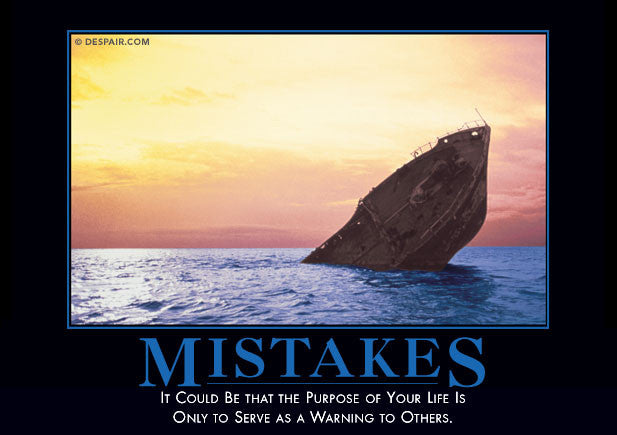
https://cdn.shopify.com/s/files/1/0535/6917/products/mistake...
It's not terribly important that you get everything exactly right as an individual (even if it was possible). The universe is large enough you can get away with your best honest approximation.
Not fantastic adventure, a very boring one. But hopefully it has some of the qualities.
Also money and hard drugs /s
It all ends up about the same with the heat death of the universe.
The rather uncomfortable truth is that there may not be a point. But this, in some ways, makes it strangely comforting also, because the "point" can be whatever you define it to be. That's the way I choose to look at it anyway!
It exists and as a result, so do you. Enjoy it, do what's right, and maybe we'll be lucky enough to be the first people for whom life doesn't end.
Life’s point is to live, and the inherent hope of all* life (regardless of species) is for life to thrive way beyond the term of one individual.
*: Caveats apply.
i don't think there's a point of life. from a nature perspective it should be reproduce and assure balance in the ecosystem, but as there's way too many humans that ship has sailed.
from the economic perspective you're a pawn to contribute to a "healthy" economy so we all can enjoy our luxuries.
and then there's the individual perspective, where the point probably is what you want it to be.
after realising there's no point at all, for me the point pretty much is "do what you want and what you're comfortable with and try not to worry too much"
You can worry about the meaning of life after you have secured its continuity. Prioritize.
That's like asking "what's the point of a frog?"
I highly recommend meditation, breath work and psychedelic drugs like Psilocybin or LSD for helping you on this journey.
Alive and intelligent? Then find solutions in the solutions space. More than alive and intelligent? Then get from there the directions for the solutions to find.
There are no second chances
There's only this moment, and the next
Where everything you want will collide
With everything standing in your way
Purpose and meaning are not to be found in the laws of nature
It is our job to create them"
Lyrics by Delta Heavy - Empire
"The meaning of life is to give life meaning." ‒ Viktor Frankl
It's simple, actionable, positive, personalizable, non-confessional, practical.
There is literature about it, by the way, and it could be good for you to explore it if you feel that way towards the matter.
And don't be an asshole.
That's the standard Sunday School answer. It doesn't work for everybody, of course. But for the right kind of believer, it answers the question.