He had a career in the Italian navy, a retired Admiral. He was a great storyteller, and had a tough and difficult character, but lots of good things, deep inside. Full of integrity, honorable.
Thankfully we moved back to Italy a few months ago after a dozen years abroad, and spent this time mostly with him and his wife, in their hometown, Venezia. I can't imagine what it would be if we stayed in San Francisco, and this death happened at distance.
Does any of you have a time machine at hand? Both me and my wife would like to tell him how much we love him, and hear his great stories one last time.
Missing that, any suggestion on how you coped with death?
It is not my first time; but it is the first time in the last decade or so. I know, I'm lucky.
One last thing: I don't want to just "ask", but I'd like to contribute something. This is my suggestion for you, actually my prescription for you: if you still have parents, or parents-in-law that you really love, invite them out for dinner, and ask them to tell you stories of their past. Then, before saying goodbye, tell them how much you love them. One day, far away in the future I hope, you will thank me.
It's very sad and recently I cry regularly. Don't be afraid of crying, it's good for the soul.
Before my mom passed she said she just wants me to live my life. Do things that make me happy because before you know it life is over. She said: of course you will be sad in the beginning but don't let it control/ruin your life (like it did with my brother, alcoholism), live your life! Do all the things you want to do and don't wait to do it "someday". That memory really helped me a lot with the grieving process and made me realize that life is for the living, let the dead be dead.
I also educated my mom a bit because we never said "I love you" so one day I told her, let's say it! And get over this awkwardness. Since that time (she was already sick) we said it occasionally and I'm very glad we did that. I told her as kids we need to hear these things :)) . That taught me that as kids it's oké to tell your parents your needs. Parents aren't perfect and the're trying their best.
So how do I cope? In my experience the people that are dying are usually afraid that their death will mess up their loved one's lifes permanently and that they are "responsible" for it. So just live life man. That's the greatest thing you can do to honor the ones that have passed. Sometimes you feel like a zombie, sometimes you feel like nothing changed. It's all part of the experience we call life. We are just getting to know more about life and all the sadness and happiness it has to offer.
This is also the most alone I have ever felt. Even surrounded by my huge family I felt alone in my pain. I consider myself extremely lucky, I have an incredible wife and loving families from both of us, and yet the grief has left me feeling isolated.
One thing I have thought about a lot is an analogy someone shared with me. They said that when we lose a loved one, we are given a box. In that box, is a ball and a button. Every time that ball touches the button, we feel pain. When the loss happens, the ball fills the box and is constantly pressing the button. The pain seems inescapable. Over time, the ball gets slightly smaller. It still will press on the button, but maybe not as often. The pain doesn’t change and it is always there waiting to be triggered, but as time goes on it may happen less.
We carry that box for the rest of our lives I guess. I still don’t know if there will ever be a day I don’t miss my amazing brother so much it hurts.
I guess I don’t really have much advice for how to deal with the pain. But it has been helpful for me to read your and other's posts on here. Thank you.
During this period we never told ourselves that we loved each other, not because it never came about, or was too awkward, but because our actions were expressions of love.
It's probably the instance that makes more sense with the cliché: actions speak louder than words.
That's how I justified it in my mind and came to terms with it for not saying it, and makes sense to me. I knew, and my mom knew, death was around the corner. But we also knew we loved each other.
Could it be that saying I love you so much meant "goodbye", so we avoided saying it?
I don't think so, we enjoyed our company and expressed our love for each other throughout our lives, and that happened until the final moment. It still happens to this day that my mom is no longer here, and will carry on until my mind fades away or on my death bed.
Maybe our believes helped us as well, since we both had a sense of continuity of life and death.
I miss her a lot.
Since then I feel more empathy, and I have a new appreciation for the time I spend with my family and friends. On the other side, things like work became a shore and I've been struggling with it... like if I'm not doing meaningful things then they're pointless and a waste of time.
Just know there are always others who also have to cope with the same loss in their own complex ways. Some people cope by changing their memory and describe the characteristics of a person completely differently, alienating your experience. Nobody will correct them, because everybody becomes so respectful towards others. Without real notice this damages relationships in the long run. It shouldn't, but at some point you can't stand the people close to you and their sadness and twisted polished stories anymore.
There is no malice to it, we all experience things differently. Do you ever really know a person? A whole life is quite a long time and some of us only see some facet of the life of others and there are things we don't want to see.
It seems strange, but the dead really don't care about this world anymore, it is only for the living. It is not about respecting their whishes, it never was, the dead are owned by the people close to them and they even decide who that person was. It is about what they need and that is the unimportant stuff you should forget anyways.
Many great mathematicians are buried with citations, they already regretted when they were alive.
But after a few years and without the haze of pain and emotions, real human and normal stories and memories can emerge again. If you lucky, somebody is there who can acknowledge them with a smile and a mind falling back in time. That is the good stuff.
May your experiences be different.
Your time machine is between your ears, it is very powerful and can be tainted by emotions and pain, so be careful when to use it out loud.
My wife left me an article series to read, in print, but it's also online, and it has proved helpful over and over again especially when I am in the deepest throes of agony. I hope it helps you and your wife:
"Help for Those Who Grieve" https://www.jw.org/en/library/magazines/awake-no3-2018-nov-d...
You'll benefit from the articles no matter your religious leanings. They are extremely practical.
Years ago I was grieving the loss a dear relative and my father shared some wise words with me. Everyone has limited time on Earth, and we should be aware of the constant presence of death amongst us. The person we lost might not be with us anymore, I aren’t we fortunate enough to have been with them and share some great moments together? Why not celebrate their life and the good memories we all had with them?
Last few days were the hardest for me, as I found myself rudderless and grieving my heart out. But slowly his wise words came back to me parting the dark clouds and eventually I accepted the finality of it. It’s still a long way for me and my family but at least I know we all will be celebrating his wondrous journey and his legacy.
So hang on there internet friend, life is a wonderful gift and we all should celebrate and remember the departed person for all the warmth they brought to us by their presence.
My mom passed when I was 15. I felt extremely horrible back then for quite long.
My dad passed away last December, on the SAME DAY with my wedding. Only a few hours after the ceremony. It was like a rollercoaster of emotion within a span of 24 hours -- from smiling and shaking hands in the morning to mourning at night.
After such events, I still do not have any good way to cope with the losses. Maybe I am now better at accepting the fact that my parents are gone forever -- no more family gathering with them, no more arguments, no more adult talk, etc. Everything just becomes silence.
So I accepted the silence. I allow thoughts of them to come to me, replay the memories in my head, then try to not hold on the thoughts. My tears still fall occasionally but such times do not feel as painful as in the earlier days.
Hope you will soon find a balance point for your emotion.
This helped me reframe the loss from "they're gone forever" to "they're alive, in the past".
It's now an inaccessible location to you, but the past exists in no less of a real way than the present moment.
And while that's not the page we're on anymore, that ink never fades. You shared those pages with them.
And if it occurs to you to think this way before they're gone, then I hope it also encourages you to fill those pages with the happiest times together that you still can.
Anyway it's been 12 years and I'm afraid I haven't found a good way to cope with it. The first few years were a nightmare to put it very lightly. But at one point I just learned to live with the thought that he's gone. Which is not to say that I don't think about him every day. It just became a norm for me and while it still bothers me and occasionally keeps me up awake at night, I've kind of accepted it and learned to live with it.
I wish I could give you a less morbid answer but I'm afraid that's the best I can do. Sorry. And sorry for your loss.
A few years ago I got myself into a into a life threatening situation, trapped in it. I was fighting for my life and I was losing. I became so tired that I had to take breaks, and I was able to reflect on my situation. At one point I felt I had no more energy left and accepted I was going to die. All concerns about my life dropped off me and all I could think about was how much I loved the people I know and how I wished them well after I was gone. It was a beautiful moment, maybe the most beautiful moment I've ever experienced. If I'd died at that moment I wouldn't have been unhappy at all.
I'm not special, I have no deep reserve of empathy that others lack, nor am I especially selfless. I've also heard of similar experiences from others who've faced a moment where they were sure death was there for them and they had the time to contemplate it and accept it. It only needs a brief moment.
Perhaps it's not like that for everyone, but those who leave us probably felt something similar because, as I say, I'm not special. They pass on feeling deep love for us, I know that now. I have a friend who passed away in the night from a heart attack, somewhat unexpectedly, and it still makes me want to cry when I think of him, years later now. But even though he probably didn't have the chance of that moment, that feeling was in him for those he loved. I would like to hug him and talk to him again, but if he were to come back, wouldn't he just tell me his hope that I'd been okay and living my life happily and well?
Of course he would.
All the best.
Just over five years ago, I lost my wife of 10 years at the age of 36 to pancreatic cancer. She went from seemingly perfectly healthy, athletic even, to deathly ill and passing inside of six months.
It wasn't fair, and in fact was completely tragic because of the person that she was.
Mirroring some advice already here: don't be afraid to cry, to feel. You have to. You also have to reconcile now with any regrets, either to decide that you really don't have them, or to think about how to change your life going forward so as to not create new ones.
But the cold, hard fact is that this is reality, both the thing that happened but also that it happens and will continue to happen. I hope this doesn't sound cold. For me, it was more of a question of "ok, this is reality... now what?"
And I recognize that different people react differently, and circumstances of deaths are very different, too.
I also found myself blogging both for therapy as well as just to connect to all the friends and family out there who shared my tragedy. Maybe something there will be useful to you, too:
https://justinmiller.io/series/grief/
Be well.
With time, the waves hit less and less often. For a while, though, it’s just the frequency that changes - not the amplitude. It will hit just as hard, and your responsibility remains the same: just don’t drown.
With a lot more time, the waves get smaller, too.
My only piece of advice is that when the waves hit, don’t focus on dog-paddling or floating or whatever stupid fucking thing people say you should be doing. Just. Don’t. Drown.
When the wave breaks, and you have your moment of peace, then you can take a moment to remind yourself that this will pass. The waves will get less frequent, and smaller.
Perhaps a touch more actionable: when my father passed, I found it helpful to engage in hobbies related to, but not identical to, his. It hit the right balance of making me feel in touch with him, without clobbering me over the head by emphasizing his absence.
Here’s my advice, having gone through a grief counseling process.
- People are sympathetic to you, but they don’t know what to say. You might run into people who just throw out a trope like “be strong” or “time will heal all wounds”. Often this isn’t really functional advice, they are just at a loss when thinking about what to say to you. The thing not to do is try to follow this well meaning advice, because while your friend might be able to suppress the thoughts about your loved one passing, you might need to actually deal with it.
- One of the main issues with common advice it when it suggests that you hide your emotions. There's no such thing as being strong. Crying or not crying isn't about strength, whether you try one or the other against your instincts it's an emotional agony that you don't need.
- I won’t say I know how you feel. Your relationship with your loved one is personal, and relationships all have specific highs and lows. Death can even be a relief for some people.
- I worked through a book called “The Grief Recovery Handbook”. It’s worth a read. It encourage you to think through your relationship and what it means to you. You end up doing a timeline and writing a short letter.
- Often all you want is someone to sit and listen to you. You’ll find you have more friends than you thought. I ended up getting my dad's life story from one of his close friends.
My grandmother was an avid gardener. Now that summer is here, I tend to it every day after job. It's in a state of desolation, with wild grass growing everywhere and empty garden beds. I weed them out and take care of the seedlings: sweating, with my muscles arching from physical work, hands being numb because of nettle burns, knees bleeding after crawling on gravel around dooryard.
I struggle and take pleasure in the labor that causes me pain, the way my grandmother did — so that she can live on in her hobby, in that pain, that very act of gardening. She *is* her garden, and *my* grandmother, after all.
  Mother to Christ, at a loss:
  - Are you my God or son?
  You’re nailed onto the cross.
  Tell me how to go on?
  How can I go, having not
  understood, grasped, derived:
  are you my son or God?
  That is, dead or alive?

  He, in turn, explained:
  - Dead or alive, this time,
  woman, it’s all the same.
  Son or God, I’m thine.

  — Joseph Brodsky, Nature Morte
So, my advice: look into your father-in-law's stories and military career; write and perform acts of bravery the way he did.
Lost my brother-in-law few months back after a long battle with cancer. My sister is still mourning. It takes time and it never really goes away fully. You just get used to it I guess.
One of the things I thought and shared with her, and which had some effect was this: we all die and we all spend our time here in various ways. Being sad for a loss means that we were lucky enough to have someone of high value in our lives. That is not a given. So, sad as we might be it's also a reason to be happy that we were that lucky. The alternative would be to never have met them and thus lead a much poorer life.
Dunno if that helps.
Now is too soon to think of 'How do I cope' It is a day to day thing. The funeral will bring it all up again. I was grateful for friends who acted as chauffeurs and managers at my mothers funeral.
If you can, write or record on a phone all the stories you can remember. Then in a year or two put them together. Which I need to do myself for my mother and aunts.
I also need to spend some time with my dad and record his stories. I think I will go in 5 year increments. I also need to do this for my wife and myself. Although typing it out sounds good, I think at the least try to get an audio recording, better is to tie in video.
Don't beat yourself up over what you feel or don't feel; what you say or don't say. In my extended family we speak of lost family members and dear friends as if they were in the next room and hearing everything we speak of about them.
It still seems pretty unreal, but, at the same time, it feels like this is the only way, and the anomalous condition is that any of us are still surviving him.
In a very short time, we will all be dead, too, and a very short time after that, everyone who ever knew us will also be dead.
It will be that way much, much longer than the few blinks of an eye in which we build little sandcastles on the crust here.
You know that big rock in the ocean out in front of the sutro baths ruins, the one covered in bird shit? That thing has been sitting there for a dozen times longer than the tall apes have been making sounds that map to concepts.
It'll be there long after, too.
Life is the temporary anomaly.
Sorry if this isn't a helpful comment, it's just some of the shit that's been going through my mind recently whenever I think about my friend. I wish I could hang out with him for ten or fifteen minutes more, or had known the last time I saw him that I would never get to see him again.
Tell people that you love them.
Your loved one will always be with you, in your memories, in your life experiences. If you get a smile while thinking of the things you did together, then they are not really dead.
Everyone deals with grief differently, and there is no right or wrong way grieve. Don't feel like you have to grieve in a certain way, no two people are the same and no two people have the exact same relationship with each other.
I'm generally the quiet type in this type of situation, I need time to myself, to process my grief and the endless stream of thoughts that pop up. Sometimes the grief just hits me again, out of nowhere. Others need to express their grief more openly and share it with others. Again, there is no right or wrong way, it depends on how you need to express your grief, to process your loss.
And don't feel guilty for starting to not feel grief all the time, that's perfectly normal and OK. It does fade over time, even if it never goes away completely.
In regards to my dad, I know he got an additional almost two decades worth of life. He started cooking more, started playing the drums again, had energy for hobbies and DIY/home improvement again, it was like a new lease on life. That keeps me thinking a bit more positively, for those times where I really miss him.
Take care, and remember your family, they're all dealing with this in different ways, some harder than others.
---
“Zhuangzi's wife died. When Huizu went to convey his condolences, he found Zhuangzi sitting with his legs sprawled out, pounding on a tub and singing. "You lived with her, she brought up your children and grew old," said Huizu. "It should be enough simply not to weep at her death. But pounding on a tub and singing - this is going too far, isn't it?"
Zhuangzi said, "You're wrong. When she first died, do you think I didn't grieve like anyone else? But I looked back to her beginning and the time before she was born. Not only the time before she was born, but the time before she had a body. Not only the time before she had a body, but the time before she had a spirit. In the midst of the jumble of wonder and mystery a change took place and she had a spirit. Another change and she had a body. Another change and she was born. Now there's been another change and she's dead. It's just like the progression of the four seasons, spring, summer, fall, winter.
"Now she's going to lie down peacefully in a vast room. If I were to follow after her bawling and sobbing, it would show that I don't understand anything about fate. So I stopped.”
I spent the rest of that evening, recounting to myself, with help from my partner, my history with her mother and recovering memories of how she looked and acted over the years I had known her. How she laughed when she was tipsy, how glorious she was when she and her husband were singing a particular song to each other. How she dressed when my partner got her doctorate. How thrilled she was to welcome someone even when she could no longer recognize who she was welcoming.
I still felt her loss from my future plans and expectations, but the loss of her that I had imposed on my past was gone. Since then I've found some people distort their memories in this way and many don't. I'm glad I discovered what I had been doing and stopped it.
However, I find it hard to say the words, it doesn't really need to be said, it is known. It's a cultural difference for me.
In return, all I can offer is the notion that you are not alone. This is something that probably all of us have to face one day.
Also, I recall the story of Richard Feynman in his old age walking with his friend joking about his surgery & illness, and his friend remarked that he is sad because Feynman was probably going to die soon. Then Feynman said that he has told so many stories over his lifetime, and it feels like he's won't really be completely gone as long as those stories are remembered.
The 42 song by Coldplay encapsulates this.
"Those who are dead are not dead, they're just living in my head"
I was 15, he was just 5. He was fine, healthy and then got chickenpox.
He was doing fine and in a matter of 24 hours he was gone.
I miss him a lot… it was extremely hard. The missing part never goes away, but it does get better, little by little. Honor their life, remember them, live a life that would make them proud.
Talk to them when you're by yourself. They somehow still live inside you.
The pain feels like it will never go away, but it will, I promise you it will, work on letting it go. They would want you to be happy.
My father died largely due to alcoholism, probably one of several complications related to childhood trauma, based on what I’ve pieced together from family, letters, and his journals. We were not very close, and the rift widened after he embraced many conspiracy theories. All the same, we loved each other (we spoke this aloud and in writing and action) and kept writing letters, generally about the weather and phenology. When he died it had been several weeks of phone-tag and me thinking about writing but not actually writing. I accepted his death and also felt guilty about not being there for him, that maybe my neglect hastened his death. I’m over that now, as alcoholism is a slow-motion car crash and he’s dead anyway; all that’s left is our memories (and his ashes as tree-food, and all the cool things he made, and all the work he did for other people’s houses, and the effect of his music, and so on). I let myself ride the waves of emotion and practice noticing what I’m feeling, and ideally deciding what to do next (I still struggle with this), whether it be to cry or laugh or go for a run.
Thank you for the nudge towards reaching out to others. The COVID-19 pandemic was useful for that, as I felt more-able to be social via writing letters.
Acknowledging commonalities has helped me reach out to those family members that have some ideological differences.
How I coped with it: My dreams actually helped me a lot. I see her very often in my dreams. In different contexts and different stories. It helped me to understand more about myself, what makes me sad, or lonely or afraid. When I see her and everything is okay with her and the dream is neutral, I go to her and hug her, tell her that’s she is dead sometimes and say that everything is fine and that I miss her. Because that’s is what I do. Something I see her she I morphing and her skin is changing to an unhealthy state. That’s shows me that I’m afraid of death. But when I’m wake I know I can’t beat death and feel strong empathy with her pain. This what I can’t handle with the most I think. Seeing her in such pain, but her pain is past.
I will never be not missing her.
"It seems to me, that if we love, we grieve. That’s the deal. That’s the pact. Grief and love are forever intertwined. Grief is the terrible reminder of the depths of our love and, like love, grief is non-negotiable."
There is a scripture: "Thou shalt live together in love, insomuch that thou shalt weep for the loss of them that die,....And it shall come to pass that those that die in me shall not taste of death, for it shall be sweet unto them;....", or in Italian: "Vivete insieme con amore, tanto da piangere per la perdita di coloro che muoiono....E avverrà che coloro che muoiono in me non sentiranno la morte, poiché essa sarà loro dolce;...."
There is also hope for those who died without a chance to receive the ordinances (though they always will always individually make the choices, with their own identity, whether in this life or the next).
And thanks for your suggestion: we will be visiting my dear parents soon.
(edit--lengthened the quote above slightly; improved other wording)
The book Love and Death by Forest Church was VERY helpful to me and I recommend it highly. It's written by a pastor who was terminally ill, but it isn't focused on religion (although it's a factor).
I lost my mom as a teenager and I'm 43 now so have some perspective on death, but I don't know your pain as it's yours. Here are the things I'm telling myself in case any of it is useful?...
I am thankful for the time I did have. I know that I will lose everything I love in this world when either I die or they die (best case). This means my capacity for loss and love are perfectly symmetrical, so I face loss with gratitude. I do not throw a tantrum that I didn't get more, as I am grateful to have had that love at all.
I know humanity at its best functions like one organism, and that organism deploys love to fill voids of sadness (as is happening in this comment section). If I look I find that in other areas of life as well, my friends, family and community at their best react to loss by loving each other more. Along those lines I work hard to have no unfinished business with anyone. The people I love know it because I have those awkward talks with them where I make sure they know it. At any moment I am able to face my own death or the death of others with peace. I don't have to be perfect in this regard, just my best.
I do not honor those that are lost with sadness. I honor them with celebration as that's what they want and deserve. Their life and my love for them was vibrant and beautiful and I must remember it for all of that. When I think back on good times with those that are gone and smile or even laugh I know their energy wherever it is, is alive.
I wish you the best on your journey.
I could not attend to his funerals because I live on the other side of the world, and borders were closed due to the pandemic. Some people tried to help me to assist with video-conferences. It's not the same, but still helpful.
These are my humble suggestions:
- Continue to live as usual. This is hard but important that you continue to enjoy your life as much as possible. It may be hard during Covid-times, but staying at home to mourn will only make your recovery slower.
- Recognize that it's not wrong to feel right and enjoy yourself at times. You don't have to feel sad 100% of the time. Achieving to feel good and enjoy yourself anyway is a good sign that you're on the path to recovery. However you will probably feel guilty of feeling well at times, and I think it's normal.
- Talk. It's very painful and I cried so many times when talking about it, but allowing yourself to cry is the best thing you can do, it's how your body and mind copes with it. Talking to a psychologist to understand your own feelings and conflicts can also be of a great help.
- Say goodbye to him. It was weird for me to have a remote funeral and not be able to be here. Even being an atheist, going to a religious place and lighting a candle was the moment I basically said goodbye to him and started to accept the reality and move on.
Whatever the religious conflicts or disagreements may be with your family, I think it's important to recognize that the rituals we do when someone dies are for the sake of the livings more than for the deads. It's the time you can together say goodbye to him, and then move on.
In any case, don't stay alone.
I'm going to write about you may feel in the future, maybe it will help just a bit, just that one time, the hope that there's light at the end of the tunnel.
What helped me after losing my baby daughter was protecting my sleep, as sadness and depression seem to be way stronger when I'm tired. Before being able to do that, I was sinking, and today it's always a risk.
Ten years after, I 'm still amazed I can smile and be happy, and this is such a joyful discovery every time: joy has become extraordinary. I felt like I would never have a real smile on my face.
Finding a few rituals helped a lot: we bought a flower I'm tending to every other day, and there's a small tree above her grave where I go sit and talk to her.
To this day, being angry at the thoughtless sentences people say is somehow helpful, like a reprieve from the sadness. No, my others kids do not "replace" my daughter. No, the fact she was a baby do not mean she was worth less than an older child. No, repeating me to get over it will not magically work, and anyway, why should I be ok with my child death?
A beautiful discovery I made is that this situation will trigger discussions, gestures, moments that will become memorable : that one time where a remote friend said two sentences that got you through the day, that nasty grandma suddenly speaking so nicely for 5mn, that touch of sun on your skin while you were looking on the place she died, the new friends you make through communities of people suffering from the same thing, etc.
Again, I'm sorry for your loss, it's not right, it's common but it's not right. For now, just one step at a the time, going through each day. At some point, hopefully, you'll see a light in the distance.
We could start cherishing small things and start normalizing death as a part of our life.
How to do this? There is no universal answer. Maybe you have to explore that with subjective value of upbringing. Tell them that you love them but also tell them that we all are going to die and end up becoming nothing but memories.
Find your own coping mechanisms after accepting the fact that death is the beginning of a new life. Hope this helps.
Very sorry for your loss.
Spending time with family and friends who also knew your father in law might help. Writing down what you remember of his stories might help if you’re worried about forgetting them over time.
One thing I wish someone had told me before my parents passed away and that I’d recommend to everyone reading this: if your older relatives have a lot of old photos, spend time with them looking at the photos and talking about them. I have an entire photo collection and I wish I had the context to appreciate it better.
Things I repeat myself:
1. It takes time and there's no way around that. 2. Accept you and your wife are both different people now. When loved ones die, you change. Part of the difficulty is to accept that you're a different person. 3. Live through your emotions, don't suppress them. It's ok to be affected by the most seemingly random things you see. 4. You don't have to talk about this all the time. It's ok to watch a movie to get a break. 5. Seek therapy - a professional can guide you through your feelings and help you making sense of them. 6. Routine helps - but don't lose yourself into what you do to hide from the pain.
I wish you both the best.
Once you accept that .. only then after some time there is a slight chance to get to a place which would be called by other people around 'coping with it'.
Try to redirect your love for him to people he deeply cared about. Perhaps they miss him and his care too and you can partly fullfill this void and make it a bit easier for them. I think you were one of those he cared about so please do not forget about yourself too.
When I remember my lost grandfather, I try to do things that he’d be happy about and things that he’d have wanted to be done when he was alive.
May your lost ones all rest in peace.
Seek therapy, now. Take time to grieve, but first, you probably need to learn how to grieve. Societies used to have extensive rituals around death, which provided a framework for processing death as a community. We're left to grieve in isolation, and it sucks.
Sorry for your loss. And take comfort in knowing you won’t always feel this way.
Since then, cancer is my no.1 enemy.
I you are researching about lung (small cell) cancer and need help, please count with me.
https://www.amazon.com/dp/0061686077/ref=cm_sw_r_cp_api_glt_...
I don't but he knew you loved him. People who have introspection after losing someone usually are great at telling people. I have lost people which is why I do and tell people how I feel about them.
No solutions but more questions for the community :
What about professional help ?
Drugs / medications ?
Emotional transference : Pets, SO ?
Rationalization vs letting emotions flow ?
Radical changes / responses ? Ultra normal behavior ?
Job searching ?
Vacations ? Binge working ?
Going through the motions ?
Letting time work ?
Emotional art pieces consumption / creation ?
Fight vs freeze vs flight ?
Reflections on our own mortality ?
Acceptance ?
Having a protocol /support system in place in advance ?
Reading comments, everyone is telling their loss story, everyone has one.
I just want to say, you are alive, life is going on, keep moving, there is nothing any of us can do at this moment, know this, admit it, keep your love in your heart, keep living happy life, there is no other way.
Sorry,
This weekend is the 10 year anniversary of my family losing my sister. She was 36 years old. So I understand that it is excruciating going through losing a loved one.
Warm thoughts to you, man.
At first we are confronted with absence. Where once there was comfort and inspiration, suddenly there is pain. It hurts to recall the strengths of this person because to animate their memory is to emphasise their distance and test our ability to come to grips with what seems like a permanent disconnection.
Over time, inevitably, as we visit this absence again and again, we see our loss for what it is - the deep impression made by a human being who moved us with a strength of character and and intimate meaning on a deeply personal scale.
At some point, we may begin to see this absence as something more than the personal impression made upon us, and more than just our loss, great though that is.
The space left by the departure of our beloved is never empty. It is the measure of the person. It is them - in silhouette - and we visit them with the respect they command. To see them in this way is to start to reconnect with the strength and joy they brought us, for their energy is still a part of us and it lives on in surprising ways.
We might not even have recognised their presence in us when we expected there would always be more of them to come. But in their absence, we see their silhouette again and again in our daily existence, in the way we respond to the things they used to respond to. They surprise us with their presence every day. In difficult times and in joy, suddenly, there they are. We know exactly what they would have said because we hear them say it. They are with us.
When we see a loved one in this light, we see them in their entirety for the first time. The extent of their reach is revealed to us each time we see them appear anew in the space we at first thought we had been banished to alone.
We weren't alone, and we aren't alone, because the connection we enjoyed has made us who we are, and we are still that person - the composition of our selves and the person who helped to make us who we are. That never changes. It just keeps growing, because each day, as we live our lives being who we are, we touch other people with the same forces that once shaped us. It is then that we begin to see their soul live on through us, with us, beyond us and all around us.
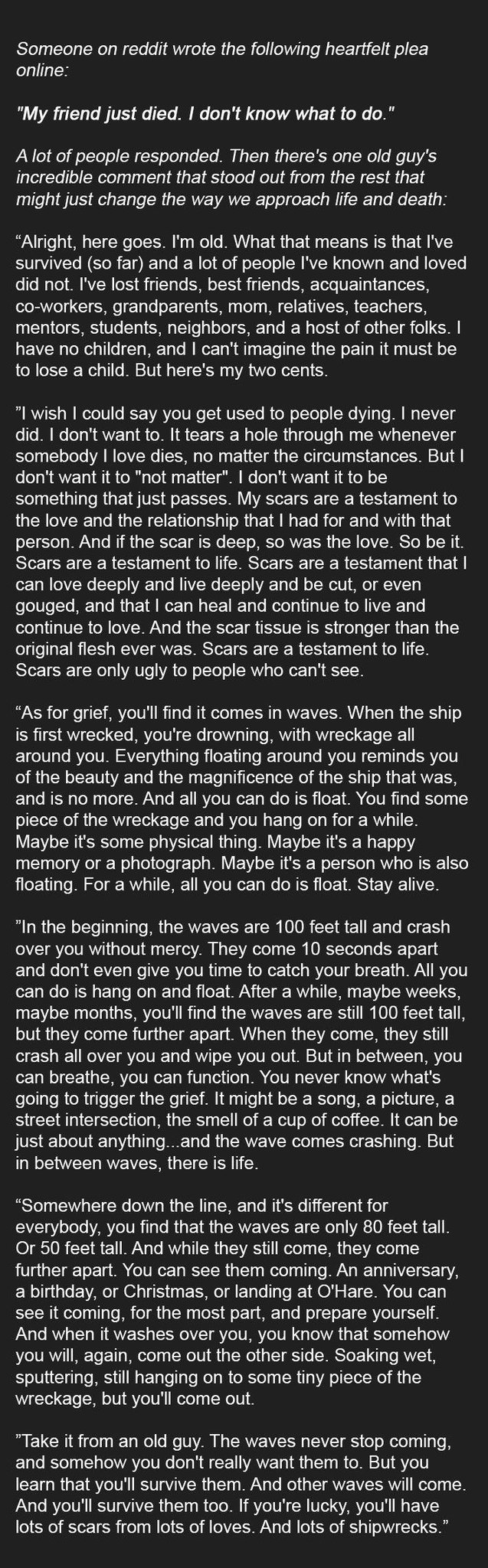
http://www.solipsys.co.uk/images/Grief_FromAnOldGuy.jpg
Someone on reddit wrote the following heartfelt plea online:
"My friend just died. I don't know what to do. "
A lot of people responded. Then there‘s one old guy’s incredible comment that stood out from the rest that might just change the way we approach We and death:
“Alright, here goes. l'm old. What that means is that I‘ve survived (so far) and a lot of people I've known and loved did not. I've lost friends, best friends, acquaintances, co—workers, grandparents, mom, relatives, teachers, mentors, students, neighbors, and a host of other folks. I have no children, and i can't imagine the pain it must be to lose a child. But here's my two cents.
"I wish I could say you get used to people dying. I never did. I don't want to. it tears a hole through me whenever somebody I love dies, no matter the circumstances. But I don't want it to "not matter". I don't want it to be something thatjust passes. My scars are a testament to the love and the relationship that I had for and with that person. And if the scar is deep, so was the love. So be it. Scars are a testament to life. Scars are a testament that I can love deeply and live deeply and be cut, or even gouged, and that I can heal and continue to live and continue to love. And the scar tissue is stronger than the original flesh ever was. Scars are a testament to life. Scars are only ugly to people who can't see.
“As for grief, you'll find it comes in waves. When the ship is first wrecked, you're drowning, with wreckage all around you. Everything floating around you reminds you of the beauty and the magnificence of the ship that was, and is no more. And all you can do is float. You find some piece of the wreckage and you hang on fora while. Maybe it's some physical thing. Maybe it’s a happy memory or a photograph. Maybe it's a person who is also floating. For a while, all you can do is float. Stay alive.
"In the beginning, the waves are 100 feet tall and crash over you without mercy. They come 10 seconds apart and don‘t even give you time to catch your breath. All you can do is hang on and float. After a while, maybe weeks, maybe months, you'll find the waves are still 100 feet tall, but they come further apart. When they come, they still crash all over you and wipe you out. But in between, you can breathe, you can function. You never know what's going to trigger the grief. it might be a song, a picture, a street intersection, the smell of a cup of coffee. It can be just about anything. and the wave comes crashing. But in between waves, there is life.
“Somewhere down the line, and it's different for everybody, you find that the waves are only 80 feet tall. Or 50 feet tall. And while they still come, they come further apart. You can see them coming. An anniversary, a birthday, or Christmas, or landing at O'Hare. You can see it coming, for the most part, and prepare yourself. And when it washes over you, you know that somehow you will, again, come out the other side. Soaking wet, sputtering, still hanging on to some tiny piece of the wreckage, but you‘ll come out.
"Take it from an old guy. The waves never stop coming, and somehow you don't really want them to. But you learn that you'll survive them. And other waves will come. And you'll survive them too. If you're lucky, you'll have lots of scars from lots of loves. And lots of shipwrecks."
The past and the future are not so different. While some of the past is catalogued in your memories, most of it remains unknown and unexplored, partly predictable, just like the future. enjoy the present and enjoy predicting the future and the past !
Have you seen all those commercials in which they tell you how important you are for them? Then you call when you have a problem and they make you wait one hour in the phone and they don't even help you at all.
You are just idealizing what should have happened, that never happened. You are like a virgin that idealizes what a relationship is, because she never experienced one. Or an American that idealizes socialism/communism because she have never experienced anything remotely similar in reality.
When you don't know about something, you idealize it, you make it perfect, but reality is infinitely complex, and different from your ideal.
I have no problem telling people around me I love them, but that is so easy to do. It is easy to love someone on good times. There are times in which loving someone is extremely hard, like a person becoming an addict or getting in love with an addict or becoming a criminal that decides to steal or be part of a gang.
We had a family member that got in love with a heroine addict. The pain for the entire family was incredible. As this person died from overdoses we had to support the children ourselves and the problems the children had without a parent, like having sex being 13 years old and aborting.
I have been a voluntary in Africa and helped refugees. I helped drug addicts. I have seen lots of situations in which loving someone is extremely painful and they do, they don't tell, they do.
I believe in God, that it probably what makes the biggest difference in the refugees that I have interviewed in all those years.
I am Spaniard, Italy is a lovely place to live. You don't have to do any effort to see the family or friends. It is not North America or the North of Europe in which most people live much more isolated.
Wallow in it
Pick up a few substances to abuse
Make other questionable decisions
Repeat above step in random order
Dust yourself off and continue with life and always hold onto your new found hollowness