With computer games, I made XYZABCDE.ZZT, as well as others in the past. (You can probably find XYZABCDE.ZZT in Museum of ZZT as well as in archive.org, and possibly more.) I also had done game engines (including Free Hero Mesh, now listed in Libre Game Wiki; more work continues to be done), and implementations of Z-machine in a few different programming languages (including C (ZORKMID), Glulx (GLUZMA), PostScript, JavaScript (JSZM), and I started one for Famicom (Famizork II) and for MMIX too, but neither is complete yet). I also did some DOS games in QuickBASIC.
Although I had not written many games for NES/Famicom and other old systems like that, it is something that I would like to see more of; it will then work on any computer with an emulator (as well as on a real cartridge, too), of which many are available. Most of these things are 100% public domain and source code is available for them as much as possible.
I had also started a role playing game (with paper, not computer) called Scientific Role Playing System (SciRPS for short), but didn't write much of it so far. It uses category-theory-based skill defaulting, equal or less on 3d10 for success rolls, SI units, "point-free" character definition (you can define pretty much anything that you want to do, with only a few restrictions needed for consistency (e.g. no attribute values can be positive or negative infinity, nor can Strength be less than zero, you need the GM's permission if you want your character to be king of an area that the GM has defined, and you cannot have "dependent attributes" without defining it as a power); it is meant to be very flexible), custom sub-attributes (there are basic attributes, and then you can define as many or as few subclassifications as you wish if you think the single number is not good enough; this rule is optional), and meant for any setting (realistic or unrealistic) in any time period and any kind of story. It is also 100% public domain (with the possible exception of optional artwork which can safely be removed and is not a part of the game rules), and the TeX source code is available.
I also invented some chess variants, and my brother also invented some chess variants too.
Also, in my opinion, many computer games are made too easy today, as well as some that require too much disk space for graphics and stuff and too much fancy graphics card and slow animations etc. However, there are still some games made these days that aren't.
Lots of little fun stuff on micro controllers and mini computers.
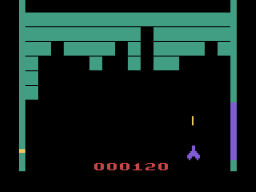
The most fun was doing one for the 2600, VCS. 128 bytes of RAM, 6502 at a little over 1Mhz, 4K ROM.
https://pdroms.de/wp-content/uploads/2007/03/20110402_ooze!....
Site is down, but there is a screenshot. Someone wanted to distribute it as a homebrew cart for collectors. I agreed and asked for a cart and have not cared what else happened.
I wanted my own cart as a kid, got one and the collectors have something to collect. Win win.
Wrote it in Batari Basic. Amazingly, that is a compiled BASIC for the VCS and now other Atari systems. Was fast, fun, lean, mean.
Was for a minigame compo. Those are a lot of fun too. Everyone writes something, gets feedback, there is voting.
This one is simple. The ooze comes down, you have to keep it at bay with your laser. There are levels where the game dynamics change for a different strategy to get through.
I learned something on this lark, and that is where the available options are limited, one can focus on the game, have some fun.
There is nothing special in the game design sense. But it was a lot of fun to make that old, limited system do something.
Now here comes the ingenious part: At the end of rubber string is a small piece of cord. You can change this new vector only within this small circle. Obviously if you speed vector is too long, you cannot make sharp turns and vice versa. Capice?
The game was a small success. But I also realized that about half of the human population will never learn to play the game. But I wont tell which half.
I wrote a little bit about what I learned from them though: The 8 lessons I learned from releasing 8 video games (https://web.eecs.utk.edu/~azh/blog/8lessons8games.html)
Ages ago I made a couple of browser games in javascript, that was my first "real" attempt at programming. I made a randomized Trumps game and one where you had to fight a dragon in a maze but you could only hit it from one side. Someone actually copied it, I was thrilled.