What are you surprised isn’t being worked on more?
Social isolation is probably the biggest cause of unhappiness in advanced countries. Having a strong social network has lots of advantages including providing better romantic and career opportunities, as well as improving physical and psychological health.
Humans have a long history of dishing out lots of money to be parts of strong communities too--country clubs and fraternities have high fees. Church goers regularly give up 10% of their (gross) income to be part of that group. Cult members might even hand over ALL of their possessions to join.
The camaraderie and experiences that go along with being part of a strong, long lived community tends to be the thing people value most in life. Yet finding those communities has become increasingly difficult in the modern era. People move away to different cities, or just don't run into the same set of people everyday. With the rise of remote work, social disconnection is only going to rise. I think there's a lot of room to create new social organizations with pretty minimal technology, and make a pretty profit from doing so. Humans are still human--they want those connections--they mostly just need an introduction.
Yes yes, I get the economical barriers. I'm past caring. It is so incredibly frustrating to look outside the Apple ecosystem and feel like the entire PC industry is content to sell the bare minimum of quality (outside of Gamer hardware, which looks obscene - but I get that it's subjective).
It's a horrible business idea on the numbers and nobody would do this, but if some lunatic out there wants to blow the money, build and sell a laptop at whatever price point you want that:
- Supports CoreBoot
- Isn't a rebranded Clevo shell and has close enough fit and finish to a recent MacBook. Read: No. Plastic. Case.
- If there is ever the phrase "panel lottery" uttered about your machine, you've messed up.
- No logos, or throw them on the underside like Purism.
- The screen has to be relatively close to the MacBook in brightness + viewing angles. Give me an option for a glossy screen.
- Trackpad must be glass. You won't get close to the MBP trackpad on the first or second pass, but try.
- Go for some crazier vertical integration ala the M1. I don't care if it blocks upgrading certain parts, since I consider the industry to move fast enough that I won't _want_ the machine anymore in 4-5 years.
- There is no need for touch of any kind, nor the ability to flip the screen or anything. Just make a damn laptop.
- Edit: high quality boutique feeling support. I don't need an Apple Store equivalent, but at least invest in this.
I get why Apple can do all of the above. I would pay literally twice what I pay Apple for a competing product. Currently, every laptop that I try feels like stepping back a few years.
The upcoming Purism Librem 14, in terms of images, feels like it could _feel_ close - but I'm not impressed with their other products so I'll believe it when I see it. I remain shocked that System76 hasn't bothered with this.
End my rant about this industry, I guess.
Ever been to a book store in Japan? Practically every book is the same size. As a result, bookshelves also are designed to be the right size to optimally fit books. This allows people to fit more books in small homes. It makes books easier to transport in book-sized boxes and book-sized bags too. You can get perfectly-fitting reusable cloth covers to protect your library books.
American bookstores are a war between publishers to stick out from the shelves as much as possible. There's not much that a bookshelf designer can do except guess and have adjustable, oversized shelving.
That also describes the state of today's packaging. With more shopping happening online, the need for items to stand out on a shelf is lower, and the need for them to fit nicely in boxes is much higher.
Nobody would force you to design your products to fit the closest available standard package size, but companies would tend to do so more often because of the efficiency gains. Logistics companies like Amazon or Fedex could offer incentives.
Pressreader gets close but it only gives you yesterday's print versions (not current online content), it has a few notable gaps which matter to me (the FT, The Times (of London), Bloomberg news among others) and it doesn't really collate different sources for the same story very well. Though I have to say it's great for magazines.
There's a huge gap for LaTeX to fill, or to potentially fill, but it's not happening. The other day I saw it described as "a neckbeard knitting circle, not viable software". As a LaTeX "fan", that hurt but it's the truth.
Over the past months, I had to collaborate with various different people across various different organizations. Everything in MS Word. I don't even hate MS Word, it's useful and its dominant position isn't entirely undeserved. But holy cow was working together a gigantic pain in the behind. I really started to loathe it (Excel is far worse and did its part too).
This was all with technical people. They could potentially grasp WYSIWYM approaches like LaTeX. Slap git and CI/CD on top and you're where software developers have been 10 years ago. But my industry is still light years away.
Part of it is how Word "just works". But it takes 5 seconds of using it until it doesn't. If LaTeX was more modern and also approachable (very ugly syntax/language. Could learn from Markdown here), technical folk could ditch Word and really upgrade their workflows. I'm sick of Word templates from 2004.
Mostly, if people do talk about social etiquette, it's within the context of not explicitly pissing people off, or looking good to your boss. I've never seen anyone talk about actually having good social interactions online.
I've had a few friends change jobs during the pandemic, and the thing they immediately tell me is that none of them have made any friends at work since starting virtually. They all just work on their own tickets, and whatever collaboration there is, is pretty transactional.
Zoom "happy hours" pretty much get dominated by two or three voices (usually of the most senior people) and everyone else just listens, because you can't have 2 conversations at a time. I've heard a bunch of the most cringeworthy techniques that managements have tried, to enhance socialization among employees.
In person, some things are pretty obvious. If someone is new, usually a good team will invite you into the conversation somehow. It would be weird if you got to your office and sat down and for days no one asked you anything about yourself. But it's perfectly fine to log into slack and have no DMs for weeks or even months.
150,000 people die every day, and 2/3 of them die of age related diseases. The developed world and China are racing towards a demographic nightmare where fewer and fewer people are left to take care of the elderly. The older someone becomes, the more of a burden they become on the young. As people get older they begin to develop the diseases of old age and have an increasingly pain-filled life. People are forced to save for a future where they have enough to survive for a few years and then pay to have someone take care of them, instead of doing what they actually want to do.
Why are we not all collectively trying to solve this problem? Dying of age related diseases is as natural as dying from malaria or childbirth, yet we try to solve those issues and pretend age related diseases are inevitable. COVID largely shut the world down because the largest risk factor for complications is how old someone is. The gains in productivity alone should make human longevity the number one priority for every government.
I also think it would solve climate change because if you expected to live much longer, the obvious problems are no longer just future generations problems.
This is the example we gave to the upcoming generations, we're fucked when it's our turn lol.
I've been reflecting a lot on this, and thinking of ways to solve this, but it's not easy - it's bigger than infrastructure or tech... it's a social problem.
It would also be a whalefall for the hosted vm industry if it caught on, which is why I'm surprised it isn't being worked on by Amazon or similar. The only company I know of working on this is Urbit, which seems at this point unlikely to take off for a variety of reasons.
Extremely simplified, all you need to do is drill a hole deep enough for a high temperature difference. Then stick in two pipes, on for sending water down, one for steam to come up. Run a turbine, add a valve to regulate how much water you want to converted into steam to be able to regulate output, enjoy your first mover advantage and price the competition out of the market.
... It's not that I do not understand that it's a lot more complicated than that - but I'm puzzled that noone is doing it on a much bigger scale.
Oil companies are the ones at the forefront of deep drilling technology,
They know that "Oil is bad" and that oil is going to run out. I'd like them to stop drilling for oil completely - but even if they keep pumping oil, why do they not cash in on this additional front and enjoy money and good PR.
So, the US number is on my Google Fi account that I pay to keep active and I get a prepaid SIM card for Hong Kong. I can switch the SIM cards if I travel back.
But why? We have two semi-independent networks, one for voice and one for data. The voice one is arcane, region-locked (local numbers cannot easily or cheaply make international calls), and subject to all sorts of restrictions and regulations.
The data network can send and receive data to anyone, anywhere in the the world, for practically free. Why are we even bothering with the legacy voice network at this point? Why can't I get one number that works anywhere in the world? Google Fi kind of does. It's great if you live in the US and travel a lot, but I've heard that if you're living outside the US and use it outside the US too much, they'll shut down your account.
Even porting the number to Google Voice isn't a solution. It only works in a few select countries and of course Google might decide to just shut it down at any time, so who knows.
Internet speeds are more than fast enough now even on mobile in most of the world that you should be able to handle voice calls with a data-only plan. If someone figured out the backend to connect it to the legacy telephone system, to just have one phone number that is independent of a carrier that you can access from anywhere with an Internet connection, they'd make a killing.
Cure for hair-loss.
Some might say it's just vanity, but if someone could come up with a cure, and sell it affordably, that would be a multi-billion, maybe even trillion dollar industry.
Going from quite balding (NW4-NW7 in balding terminology) to a full head of hair makes most guys look a solid 10-20 years younger.
The hair-loss industry has been in a permanent state of "in 5 years..." for 30 years now.
And yes, I know there are more pressing issues in the world of medicine, but it's a real problem for tens of millions of people.
For a long time Becker's book was about the only thing out there: "The Body Electric: Electromagnetism and the Foundation of Life" by Robert O. Becker https://en.wikipedia.org/wiki/The_Body_Electric_(book)
Now there's pretty serious progress being made at Levin's lab: "What Bodies Think About: Bioelectric Computation Outside the Nervous System" talk by Michael Levin https://www.youtube.com/watch?v=RjD1aLm4Thg https://news.ycombinator.com/item?id=18736698
Ag is the material basis of human society. We have to stop destroying soil. We have to stop poisoning ecosystems. We have to minimize artificial fertilizer inputs. We have to stop emitting and start sequestering atmospheric carbon to mitigate climate instability.
If we don't do this we will likely see widespread crop failures and food shortages within 50 years. Land use practices must be reformed to protect soil health. Agriculture must become carbon negative. It may be possible to tweak crops to increase CO2 incorporation rates and store more carbon in soil, for instance.[0]
I want to leave future humans a planet with fertile soils, a stable climate, and vibrant life. I do not want our grandchildren to live in concrete domes and eat out of yeast vats.
Automobiles kill ~6k pedestrians and almost 140k are sent to the ER in the US - many of which will have life-altering injuries.
https://www.cdc.gov/transportationsafety/pedestrian_safety/i...
We have degraded 1/3 of the top soil in the last 150 years. At the current rate, we won't be able to grow food in 60 years. This is a significant threat to our food production capabilities as a planet, and has severe 2nd, 3rd degree repercussions as well.
At the moment, agroforestry and syntropic farming are the only large scale solutions, but they need mass adoption.
https://www.scientificamerican.com/article/only-60-years-of-...
Similarly: I'd love to have a little reading sconce on my wall next to my bed, but running a circuit through the existing walls without tearing them up is impossible. Why isn't there any attractive battery-powered home lighting? Sure, maybe overhead lights for lighting a room need more draw, but there's no reason to plug in a desk lamp, wall sconce, or coffee table light every day. Especially for renters who aren't about to hire an electrician—why no battery-powered lights designed for the home? Periodic recharging is annoying, but it's better than literally not being able to have a light where I want it.
There's a market here and it's not new technology. It's just repackaging existing technology with a splash of industrial design. Hell, the battery requirements for my drill are much greater than the battery requirements for my immersion blender. It shouldn't even be expensive!
I can't be the only person who uses graphs, flow charts and images as a primary mental model for idea representation. This a domain I have been obsessed with for ages. The tech seems to be there. Ocr, shape recognition, pen technology is all there. New devices increasingly have the ML hardware to support it.
Why isn't it here yet? We are living in the midst of a remote collaboration revolution, with notion, airtable, teams and slack becoming the norm, but this one thing seems to be completely sidelined.
I would have blindly jumped headfirst into making such an app if I did not have serious visa related causes holding me down. I can see it, but it just isn't there yet.
p.s: I have spent days finding a good app. (onenote is my begrudging compromise for now). Send me a good one if you can. There isn't much on apple either, but I care more about the windows ecosystem.
We've invented this artificial energy scarcity problem by refusing to use the cleanest and safest solution out there, even traditional 60's era nuclear power kills fewer people per unit of energy produces than any other source of energy.
I put this down to virtue-signalling more than anything else, but even so, nuclear energy is what I'm surprised we're not working on more.
Things like road surfaces that don't need to be replaced every couple of years, or better consideration when large infrastructure spending comes around how those bridges, dams, water works, etc, etc will be monitored, maintained and expanded over time.
I don't understand why the Web Browser ecosystem is stuck with Extensions, and why Web Browsers, the most used programs on the planet, are still unautomated for 99% of humans.
This just doesn't make sense in any economical or rational view.
Web Filtering and Ad Blocking are things that are stuck UX wise, because currently there are basically two different concepts. Either you have some scammy anti-virus firewall premium service that does things you don't understand, or you have an Ungoogled Chromium with uBlock Origin and uMatrix where you can block per domain basis (which most people don't even understand in terms of terminology).
Why is the Web not allowlisted?
Say you browse a website, and you disable everything by default. Then you want to allow a payment provider because you want to buy something, and you click on "Allow PayPal".
Wouldn't a collective list of services and SDKs and their required assets in the form of a named "web service" list make more sense than the adblocking approach?
I think that this can be improved a _lot_ in its UX.
Coming back to Automation of the Semantics of the Web:
I think once a Web Browser gets smart enough to understand the semantics of a website, and the implications of user interactions ( e.g. "make a payment" or "subscribe to channel") - it can be recorded, trained, and automated.
And I think this is the reason why I started to build a Browser from scratch, even when it is an almost impossible task to do. I believe that Web Automation is a necessary step to get to a superintelligence level.
And such a Browser would push our collective efficiency far beyond what we can imagine right now.
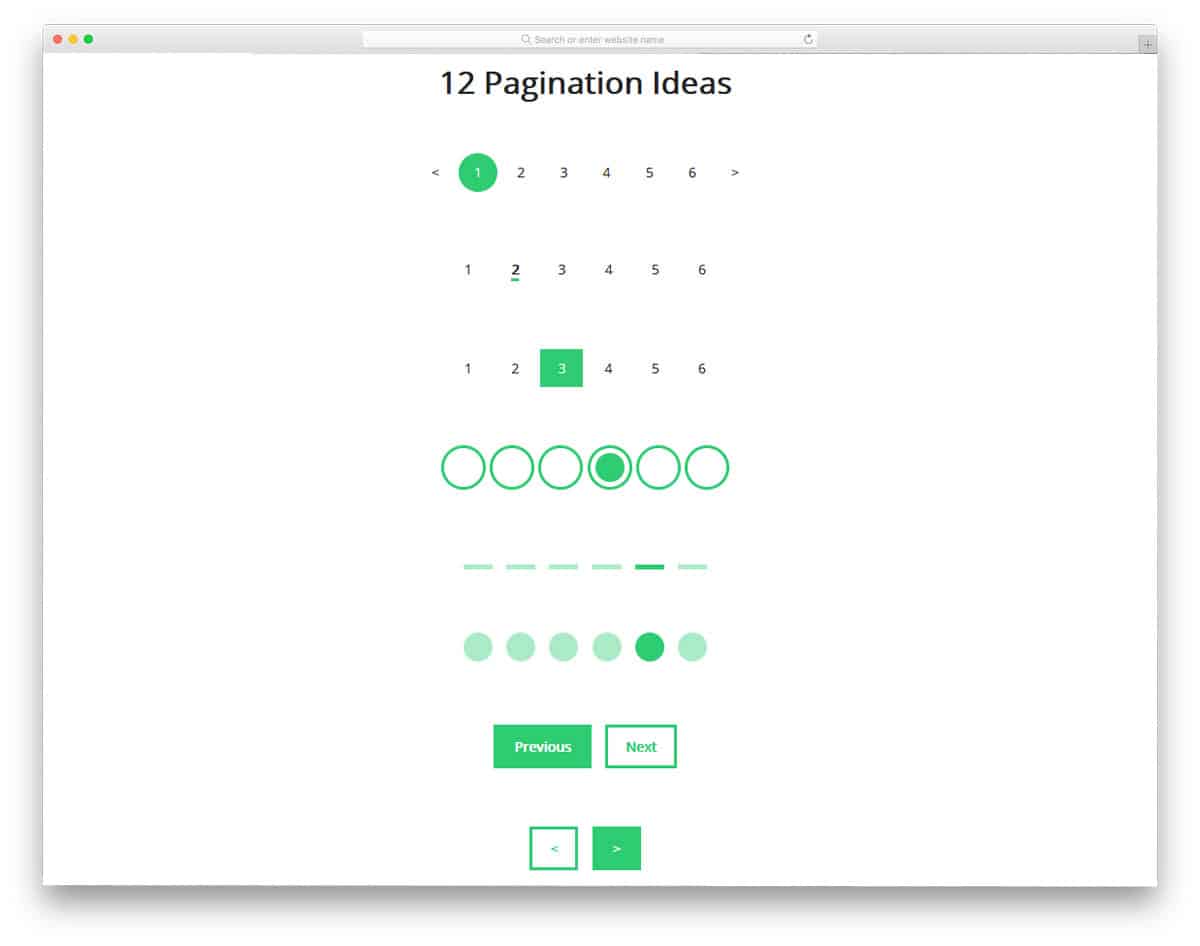
Random examples of the state of the art, which is remarkably similar to the state of the art, oh, 15 years ago:
https://freefrontend.com/assets/img/css-pagination/paginatio...
https://uicookies.com/wp-content/uploads/2019/03/Pagination-...
https://i.pinimg.com/originals/4a/af/58/4aaf58f56e598e6c485e...
Rather than everyone selling a SaaS which they're just hosting on AWS anyway, they should just have a one-click install of an instance to my personal AWS. There's really no reason it should be any harder than installing an app to my phone or computer.
I've seen one or two "launch on AWS" buttons about, and they have a marketplace, but clearly these aren't widely adopted or useable.
I think this would open up some interesting opportunities for non-technical individuals and small businesses. Plus then you know you own your data.
I cannot type a single sentence without making a typo and I have been using a smartphone for 12 years. I miss Blackberry's keyboard. At the moment I even cannot use my natural keyboard layout with a fast and responsive keyboard. I type 3 times slower on my phone than on a computer keyboard.
Seems like we got to a search bar that can answer any question we type in but haven't thought beyond it. Like what if we were recommended what questions to ask in the first place?
Thinking out loud here: we generate a ton of data just by browsing and existing on the internet. This data is plugged into recommendation algos to serve ads. What if instead these algorithms were tuned to serve us direct websites or text that could provide our next source for inspiration?
^I'm working on this idea, still pretty early stages but it feels like the time is right to create such technology. Do reach out if you want to collaborate or riff on it.
I see mental health care as one of the most important problems of out time, at the root of so many of the issues we see in society today. Yet government has been very slow to act, which in turn means insurance companies don't modernize their reimbursement policies, which then stifles innovation.
Yet, our current web standards are GUI and CRUD un-friendly. To be desktop-like in a browser requires giant JavaScript libraries which are clunky and buggy.
GUI's may no longer be sexy, but they still run the backlots of the world and that's not likely to change within the next decade or more. Mobile UI's are a sub-set of rich GUI's, which logically means they don't have the same full ability. I could list several UI patterns GUI's do with fewer human eye and finger movements.
So, let's create a state-friendly GUI markup standard so we can have rich GUI's in browsers without requiring bloated buggy JS/CSS libraries.
And somewhat related, our current web standards have too many "positioning problems" such that they can't replace PDF's. PDF's are needed because end users (non-IT office workers) want WYSIWYG documents; they can't afford to go to CSS school.
Meanwhile, I believe cars could do motorway driving from entry to exit today, if we focused on that. With LiDAR, some extra safety hardware on roads, coordination with local highway services, a company could make a car that is fully self driving on specific highway stretches.
Collection of environmental/lifestyle information of cancer patients. I know it would lead to a ton of stupid headlines, and correlation does not equal causation, but I think if you have cancer they should ask where you live what you eat what products you use and whatnot. Atleast for the cancers that do not have well known causes.
Superficially, why is there no standard video streaming api. Do content/platform owners really want to be in the app business? They are all bad it.
There are tiny vibration units like the one in your phone, why aren't there sex toys with 200 of them and various patterns going through them?
Why are there no sex toys that use expanding or contracting materials like electroactive polymers.
The sex toy market is apparently 26 billion and growing.
Why isn't there a way to load up your groceries in the store, put them in your car in a modular way, and help you unload them into your house somehow?
It could go even further to mini palettes that can be loaded and unloaded automatically. And even electrical cool or cold boxes to keep stuff at the right temperature as you drive home.
Though a not well studied phenomenon (thankfully), it is well documented and seems to be a reliable, if brief, predictor. Even if it is only a few seconds of warning, that could mean a lot of lives saved by announced warnings or via automatic means.
https://en.wikipedia.org/wiki/Earthquake_prediction#Animal_b...
Or: really efficient petrol/diesel cars that weigh 600kg and consume 2l/100km (that's about 120MPG).
Cycling is a great mean of transportation, it's ecological, healthy, quiet, convenient. Lack of safety and theft are hindrance to more adoption.
That products are design for repairability and sustainability in such a system.
Third an economic system that is not built upon debt slavery but promotes individual freedom in the age of robotics.
That would be the three main things that needs fixing. Plus most countries needs four-seven weeks of vacation per year. This would promote healthier work life balance. Four day work week another one for work life balance.
In the early days of computing, we quickly came up with the spreadsheet and the user-friendly relational database (Access, FileMaker).
Then we just sort of stopped. The no-code thing today is a step in that direction, but we could do so much better.
I’m actually ashamed of the software industry that we have done so poorly at this.
There seems to be so much that can be easily automated by simple scripts. We just need a better UI and a better way to teach people how to use it.
Cost of dealing with miss raised children is very high.
That's programming 1.0, and we're need programming 2.0
What I mean about programming 2.0:
- better security
- less bugs and more stability
- less complex code and API
- less APIs
- no halts, reactive live coding everywhere
- less coding, NoCode variants
PS: Who works on programming 2.0 besides me https://animationcpu.com/ ?
It's the main source of humanity's current woes and will only get worse with time. We seem to be content with addressing the symptoms rather than the problem. The idea of population control is taboo but will help everyone in the long run.
I realize that a fully-general voice interface is an "AI-hard" problem, but surely we can improve over what's on the market now?
Examples: quantum mechanics, string theory, certain advanced algorithms, AI etc.
It's being worked on, but not nearly to the same extent as machine perception. And yet it's probably the biggest technology gap preventing us from deploying human-equivalent robots in unstructured environments.
I've seen older (yet still updated) implementations/portals, but I'm surprised nobody has made federating site scripts easy for client-side use to expose as pseudo localhost site APIs and a portal that resembles Craigslist to bring all of the data together. Again, this has obviously been half done, but it's not packaged for mass appeal ala popcorn time for general web info.
Movies work like this, I can pay $15/month for Netflix OR I can just rent a movie on Amazon for $3.99. Why not for Web content?
In light of that: I'm surprised we're not better at spreading awareness of, and prioritising, problems.
For example news. There are thousands of topics. They are hierarchical. Every news article touches some of those topics to various degree. I would love to subscribe to some topics with some kind of tolerance. Like I want to know about most important world political news. I want to know about important IT news and my country political news. I want to know almost everything about Java, cryptography and my city news. I want to get every content from or about my favourite bloggers.
And that should be extended to all kind of new content. News, articles, videos, tweets and so on.
If we must commercialise it, more people with money = more customers.. Apple, Amazon, etc.. there's billions of potential iPhone and Alexa users out there long term if you set something up to help them now. What, you don't think you'll be around long enough?
Before buying something I want to know all CONS about specific thing, service, product, car, real estate, etc...
Everyone pitching PROS. I want to know CONS BEFORE I commit.
There are millions of assessment items created and administered by instructors everyday in the United States, but the results are unreliable so we spend billions on standardize testing which is “trustworthy” while also (often) having negative externalities. We accept this dual system because the two modes of assessment have different goals, but it is wildly inefficient.
If it were possible to create an assessment platform that supported the rapid generation of unique and trustable assessments[1], we could have 1) more frequent/less costly assessments of student progress, 2) better instructor accountability, and 3) greater opportunities for non-traditional educational pacing.
[1] more ‘contextual autocomplete’ than ‘discrete item creation’ as a primary mechanism for assessment creation. Yes, someone has to create the original bank of assessment materials - but, for the love of god, how many times has an assessment been developed on “To Kill a Mockingbird”, the Pythagorean Theorem, etc? Make the tool slick enough for content creation that it is at least on par with current offerings, do automated assessment analysis a la College Board, et. al. in the background on all submitted content, and then allow the instructor to create an assessment based on the class & lesson context as easily as accepting/rejecting a list of questions as a final “cultural fit” culling. Ideally, this final step would be completed as quickly as the instructor can read and reject assessment items such that they could - conceivably- be able to create and administer an assessment during a lesson in a manner that is reactive to the immediate progress of the students. Reduce the assessment feedback loop time this much and the ground would move under the profession.
Edit: for those asking via email, the core tech here to be developed (at least initially) is automating the assessment analysis: how do you know the assessment items are correctly assessing what you want them to?
Once you have that there would be downstream effects on instructional design, pathways to graduation, talent identification, etc. - but that’s the special sauce.
The labor of assessment analysis is what provides the creators of standardized tests the ability to maintain a monopoly on trustworthy assessments. They will not themselves develop the tech to do this analysis in an automated and distributed fashion as it would undermine their core business. In this way, they seem to be trapped in a classic innovators dilemma.
I've been writing auth for the web since 2005 and it hasn't gotten easier or more convenient as a programmer or as an end user. The problem is so bad that email/password combos need to be managed by 3rd party services.
Migrating away from Google Authenticator was a massive pain for me this year and as we continue to use more services, this problem will grow.
Some apps on my phone started using biometrics (face id) for authentication and it's extremely convenient.
It may sound amusing, but there really are many sexually frustrated individuals who could potentially see massive improvement in their social and physiological life and lead to a net gain for the society. Also it might lead to a reduction in the overvaluation of sex in romantic relationships and thus happier couples. Add this to its potential of sexual education (by having realistic simulation devices) and it might just compensate for the damage pornography has done.
Designed for the user, not for developers, or cooperations.
All these initiatives like SOLID, ad blockers, regulation & censorship should not be needed in this new alternative.
Power was given to devs and we ended up with web obesity.
Power was given to cooperations & we ended up with subversion.
Then when people asked regulators to fix it we ended up with popups.
The web is currently rotten beyond repair. We need an alternative
Instead, one could imagine a programming language platform designed to transpile the new language to multiple underlying platforms. Like LLVM IR, this transpilation platform could be a nexus that supports many different frontends and many different backends. Such a transpilation platform would make it easier for new languages to be useful sooner.
Like many other things, I guess the demand just isn't there. And even though Bluetooth devices have made having things in your ear all the time way less stigmatized than they were when I was growing up, there's still a bit of embarrassment about having something like a hearing aid in your ear. It's a shame, really.
Here's a "wishlist" of features I'd like in such a framework:
- Absolutely no boilerplate code: It should feel more like a powerful templating language than a general purpose programming language.
- A static type system that's checked before your application can go live
- Vertical integration, especially towards the database: You could go really crazy with this. LINQ-style query-ability is just the beginning. Imagine if you had a typed access control framework that lets you specify which users/roles can access a database column. Or built-in ways to handle migration and automatic schema checks to prevent mismatch issues.
- Useful primitives, especially around authentication and authorization: For something simple I should only have to write my business logic.
- FFI (for example to C or JVM libraries)
- Automatic and safe dependency updates
- Poverty
- Inequality
- Racial Discrimination
- Affordable Health and Education
- Old Age Care
The list goes on. We are 200 years into industrial revolution and have made significant scientific and economic progress. Time we start looking for solutions to the really Hard problems.
Just think of all the good it's brought and how underfunded it is
• Social connection apps (dating/friends/hangouts) that aren’t optimized for fleecing users
• VR tourism
• Some way to digitally record and recreate smells, scents and odors
• A unified paradigm for controlling machines from fridges to elevators. Like tiny touchscreens with a modern and accessible UI you can hook up to with your phones
Easy to use, type safe, automatically validated/decoded/encoded/documented interface boundaries. There’s awesome tooling for this and nothing I’m aware of checks all those boxes, at least on platforms I develop on.
I’m considering experimenting with solutions for the former, and actively developing a solution for the latter for TypeScript/Node.
In all of them the events and message buses are kind of an afterthought. Everything seems geared towards request-response systems, and nothing adequately deals with the range of event systems and message flows.
It seems to solve several issues with apps like Tinder / Bumble etc. I guess a negative is that it's more nerve-wracking to video-date complete strangers, and to ensure it doesn't go the way of chatroulette.
Over quarantine I started something in this space [1], but I thought some of the larger dating companies would have introduced products around this concept too.
2) Universal charging adaptors for electronic devices.
3) Charging for disposal of oversize trash like appliances and furniture. Reduce the bad habit of buying cheap junk only to toss them in a couple of years. This is how it works in Tokyo and consumers think full-life cycle cost of a product, not just the upfront cost.
4) Grocery trucks that make their daily rounds in urban neighborhoods so all people need to do is walk up and purchase fresh food. Reduces the need for grocery delivery which requires a lot of packaging. Basically same as food truck idea, but for fresh groceries.
There are many new and small institutions being formed all the time (e.g. HOAs; new companies; local non-profits; technology standards committees; etc) but few of them experiment with new and "experimental" procedures, and few experimental procedures are proposed (which could be a bit of a chicken-and-egg problem; maybe no one wants to try out a novel procedure unless it has been at least analysed a lot, but maybe no one wants to spend time inventing and analysing novel procedures if there is little chance they will be used).
In addition, there is little work on novel procedures for self-governance of large asynchronous online communities (such as forums).
Self-replicating cells that can be programmed to perform specific tasks.
The first protocells will be bacteria with heavily modified DNA. Eventually, we’ll be able to build fully-artificial self-replicating protocells (more “artificial cell” than “small robot”). Being fully-artificial will help us integrate new tech that nature hasn’t quite discovered/made-full-use-of yet — like different battery techs, RF communication, transistors, etc.
Here’s a good paper exploring the topic: https://www.mdpi.com/2075-1729/5/2/1019/htm
Imagine a blob that could wash along the floor, clearing 100% of detritus and intelligently depositing it — or perhaps even recycling it.
Imagine being able to repair a worn hip joint by injecting then commanding these protocells — no surgery required.
Imagine them self-assembling into structures to transport, deposit and combine material like an advanced 3D printer, building objects to incredible detail, or massive structures quickly, or both: massive structures with incredible detail.
Imagine programming them to kill all COVID-19 virions!
Did I leave anything out?
Given how important the knowledge economy is, I would think that significantly more money (worldwide) would be invested in researching promising delivery models. Admittedly, I have no idea what those are either.
Google failed miserable with their invite requirement.
Endometriosis is a condition that affects 10-15% of adult women, that can be extremely painful, that we barely understand, and that we can't effectively treat most of the time. It also confounds a lot of the conventional understanding of the source of pain, which means we might get some interesting insights from studying it further.
Unlike the NoSql movement, it embraces SQL and many RDBMS conventions to reduce the learning curve. It only removes or changes RDBMS features that get in the way of dynamism, but keeps the baby in the bathwater. And it allows incremental tightening of constraints/types to go from prototype to production. I'd love such a tool for prototyping.
This "isn't being worked on" topic is large and popular; I suggest follow-up HN entries break suggestions into categories for further discussion. HN is about innovation and the future.
I miss the C2 wiki for documenting opinions on various suggestions, and allow slower pondering. Nothing has replaced it for that function.
So yeah I am shocked that this very urgent matter is not being discussed and challenged yet at a mainstream level
And I don't mean some obnoxiously advertised chrome plugin but a core part of spell check on my devices.
Also while I'm here: ios autocomplete is infuriating. It's constantly learning complete jibberish typo words and so I have to reset it every few months.
Credit card numbers that when given to a scammer trigger an investigation into the scammers finance network. Each person can be given a unique scamCatcher number.
I'm sure it's illegal in a bevy of different ways, though.
Maybe sad more than surprised
Almost every company out there is collecting tons of data, but 90% of companies don't have an IT department capable of keeping it safe and compliant with the latest regulations. Companies thought data was an asset but as the hacks and regulations pile up I think they will begin to view it as a liability.
So what are their options: 1) Try and beef up your tech operation. Maybe spend $xxM with AWS and hope their customer engineers can set you up right. This is a distraction from selling cars or whatever it is that you actually do, but the shareholders like that you're modernizing I guess. 2) Buy insurance. The same thing that people do to prepare for any other potential disaster that they can't prevent. If Russia decides to hack you there's nothing you can do, but at least the insurer will cover the bill.
The key is that this should NOT come from a traditional insurance company. Those companies do not have the ability to assess the risks properly nor do they have the expertise to recommend simple preventative measures or help a customer recover from an incident.
Instead there needs to be some sort of combination Cybersecurity consultancy and data insurance company. They come in, audit you, fix the low hanging fruit, and insure the rest. Maybe they even sell you some cloud services too for data warehousing, etc.
All the cloud companies are trying to sell Kubernetes to every traditional company out there. Forget it, just sell them insurance.
Also mental health issues (which is closely related to human rights issues). After watching Medicating Normal, I've lost hope in the psychiatric/pharmaceutical system. Why are there no better solutions to depression? It seems to be affecting a large number of people.
Local news.
Twitter is too noisy, nextdoor has too many busybodies.
ML is great, but at the end of the day you need some logic in order to make sense. Maybe some combined system could try to take on the knowledge acquisition problem?
Phones that don't copy all of Apple's dumb decisions.
Space exploration, particularly in LEO manufacturing.
And, technology to efficiently cut the bonds between atoms in any visualized part of the body.
What would something like this require? What is missing? I would expect this to be the next step after MRI/electron microscopy and gamma knife.
If this existed, we wouldn’t need vaccines for Covid, we would just shoot the bonds of those ... . Also the same cure for cancer cells.
So we can optimize farming, cultivation and stocks of food, reduce waste by insane amount and make sure everyone has a healthy diet, no matter his income range
Or better, globalize and generalize powdered meals (a la Soylent)
Where's that moon colony we were promised?
I think at this point it's clear that market economies are good at getting people out of bed, and for innovating, finding new markets, optimizing for efficiency, etc, and generating 'wealth'.
But they are perhaps not good at creating the right kind of wealth, spreading it fairly, fostering healthy societies, respecting the environment, optimizing for resilience, sustainability, etc.
It isn't really fixed by what we do now; tacking on taxes by government - which is always seen as 'lazy bureaucrats stealing from wealth creators', etc.
We should be researching, and testing alternatives, built into the very fabric of how economies are structured, along with ideas like Georgeist land taxes, universal basic equity/dividend etc.
It seems like the AI field got stuck optimizing a particular (and very primitive) decades old ANN model, which is a dead end in my view.
2) Alternative nuclear reactors & fuels, it seems like the field is stuck in iterative improvements on decades old LWR/PWR designs.
It's the next billion industry.
I wish people would stop wasting time on AI and speech recognition and work on that, it's the next step. ( AI obviously might be needed for 'deep fakes' of good speech output, we need focus on AI that gives us achievable returns, in steps )
Think about how quickly science could progress by sending back results from experiments performed in different timelines.