- Play "identify the waterfowl in the park" followed by "chase!" and (for larger geese and swans) "run away!". [This should satisfy the other comment "play sports instead".]
- Then, collect sticks in the woods and build a shelter. Extra points for using different types of structure, or working out which tree the different sticks come from.
- Collect different leaves and paint them. Or paint rocks.
- (In a year or two, you can get a plant press / heavy books and dry flowers and leaves between old newspaper.)
- Grow seedlings. Grow cress and eat it, or tomatoes, or just flowers.
- Search for fossils, bones, seeds (acorns, conkers, pine cones etc)
- Make a paper or balsawood boat, and float it on a pond
- Look for sea creatures in a rock pool
- Make an insect haven, then look at / identify the insects
When I was 3-4, I had a table placemat called something like "At The Seaside"[2], with typical creatures found on the British coast. My sister had "In the Garden". You might find something like that at a local museum, or some other child-appropriate guide to local flora and fauna. The museum probably has plenty of other STEM toys.
[1] https://www.nationaltrust.org.uk/features/50-things-to-do-be...
I'll just second some of the common recommendation:
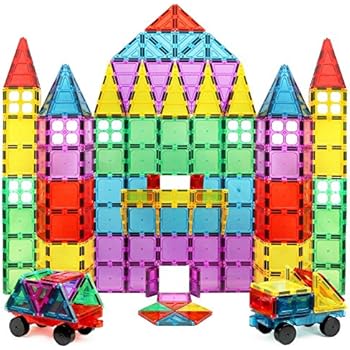
- Magnatiles. There are a lot of manufacturers out there, some brand name, some not. The good thing is that at this point they have all standardized on the tile sizes, so they are usually compatible.
- LEGO Duplo. The standard LEGO sizes are too small for most toddlers. Duplos are perfect. Kids (and parents) quickly tire of the set themes, but the good news is that you can mix and match pieces and let the kids build whatever crooked houses they want to build.
- Trains and other vehicles that go on rails.
- Picture books that you can read to them while they can follow by looking at the pictures. This is tricky, because in my experience most children books are not great. The biggest problem is usually the lack of a story. Many books are supposedly educational or teach kids good values, but they are poor at story telling. If there is no good story, kids are not interested. Many books also don't have a good balance between text and pictures. Too little text and there's not much for you to read, they'll flip through the book in seconds. Or pictures that do not have enough detail to match the text. Anyway, the only solution is trial and error.
Admittedly, none of these are exactly "STEM", but I think that's OK. What's more important to stimulate creativity and make learning fun.
In short, they just need access to things they can observe and manipulate.
While a parent can to some varying degree influence the attention and interest of the child, there is plenty of doubt as to whether this will result in a better outcome long term or not.
As other people have said, one of the best things you can give your child is your time (and undivided attention).
https://www.robotshop.com/en/code--go-robot-mouse-activity-s...
It's a great introduction to programming. You have to put in all instructions on the mouse to solve the maze. There's also cards with instructions that you can place on the board to make it even easier.
We also bought an IoT kit from from https://littlebits.com/ when he got older that we started to work on together.
The key here is to do it at a 3-year old level and that you do it together, it's not about finding the right solution or not. Be open to your kid's creativity and don't just follow the instructions.
Also, Magna-Tiles! https://www.lakeshorelearning.com/products/blocks-manipulati...
We bought a starter kit (pretty expensive I know) but my son has been playing with it for at least 1-2hrs a day for a year. They are part of every game he plays, whether it's a car race or playing with dolls.
Be prepared for about a decade of being bored with kids toys. Also realize that your child may not be interested in anything you are interested in, its ok. They are their own person.
The cool thing is that you can read content that you are interested in. Even hacker news comment threads.
I'm 40 this year, I still remember this vividly. I guess marbles would be too edible (ha), we always did this outside (fresh air), we were building things, and I just remember it being magical watching the ball _finally_ go down. And then two balls, and then three...
I'll second Duplo - that was my precursor to Lego, which was my entertainment for YEARS (before I found computers, anyway).
Also let him join in with things you do around the house (cooking? cleaning up the yard?) - just giving them something to carry so they can be part of it will make them so happy sometimes.
As a parent you can turn most any activity into an opportunity to learn math, science reading or whatever. Just asking questions is the core of learning. For example, the start of learning math is gaining a deep understanding of basic numbers. Simple activities go a long way... count things, add them together, split into groups, and so forth.
https://www.target.com/p/magna-tiles-clear-colors-37pc-set/-...
They are a little pricy but one of our child's favorites.
LEGO and LEGO Duplo is a good choice too.
We used to do science nights too, with simple experiments, answering your child's questions about anything, how does this work, etc.
Once they are a little older Lego Mindstorms (Robotics) are great, check out Lego First Lego League, we coached a team for a few years, great experience.
Littlecodr is awesome for that. It’s just a set of cards with instructions like move forward, turn left etc. get him to program you. It’s funny when the instructions lead you into a wall instead of between the door frame. Failure is fund
Some of the best stuff is also just dumb hands on stuff. Playing with cardboard glue and string. Making spaghetti towers. Folding paper planes. Magnets are awesome. Basically they learn from you, so the more time you spend together the better.
If your looking for low energy investment check out primo (primotoys.com). It’s little wheeled bot you program with simple physical tokens.
Osmo is also cool but I find the iPad platform derails their attention.
Littlebits is also cool, but the parts are a bit small for unsupervised play at that age.
Makeymakey is also rad.
Adafruits circuit python is awesome as well, but the play sessions would have to be quite curated. You could preprepare stuff and just do the wiring together with crocodile clips etc, but in all honesty maybe just a battery would be fine ;)
Looking forward to what pops up here :)
b) I had some success by playing boardgames (even Carcasone) at this age, with some rules-simplifications
c) sometimes we played games on my phone, Monument Valley, I love Hue, Chuchel ...
d) Buying and launching a model rocket was a success, if he'd enjoy watching from the distance and then trying to find the rocket again :-)
e) in simmilar fashion, building a kite (or buying ... tbh I usually do both, because building is fun, but the store-bought actually works :P ) ... but you need good wind-conditions to fly it
f) museums are surprisingly good these days, especially modern technical museums can often entertain both 3yo and 30+yo
This principle can start at a very basic level, like don't give them a ball until they find a small round rock to play with or let them use a chunk of charcoal to draw with before giving them a pencil.
It goes further:
- give them a few batteries and LEDs before giving them a flashlight
- give them some logic gates before giving them a calculator
- make them come up with a problem that can't be solved on a calculator before giving them a computer
- giving them a text-based computer, and make them create something that generates ascii art before giving them anything with a GUI.
- force them to create some sort of networked application before giving them social media.
Etc., etc. I know that in practice, the above sounds ridiculous: kids will grab that iPad as soon as they can use their fingers. However, the point is that there must be an incremental way to introduce kids to technology that forces them to learn, and rewards that learning with more sophisticated technology and learning.
When my kids were that age, frankly, it was more about mommy than me.
Still, we built an awesome wooden train table (Thomas trains, tracks, etc.). I also gave them an old IBM keyboard, the kind with the keys that click. They loved sitting on the floor next to me while I was on the computer.
I also got them involved with any project I did in the shop (so long as it wasn’t dangerous). For example, I’d have them help build model airplanes (hand me tools, parts, hold things, etc.).
I also took them to the flying field and had them fly with me using a “buddy box” (two transmitters linked for teacher-student control of the same plane).
And fishing, even if it is using a lure without real hooks that looks like a little fish (after I clipped off the hooks). Definitely fishing, nothing compares to quality time fishing on a kayak on the lake.
The common thread is 100% personal involvement. That’s the only way it works, even if all you have are cardboard boxes (which should not be underestimated, BTW).
I don't think you need to worry about anything STEM specific, just find ways for him to practice dexterity and imagination. If you want to push for STEM stuff, he'll be much more capable around 5-6 years old (my 5yo loves Legos, puzzles, math, reading).
In fact, your child is probably more likely to be interested in STEM stuff by watching you than you buying stuff for them. My older son got into Legos because my wife did, he likes video games because I play them (helped me build a RetroPie), and he helps me build/fix stuff around the house to spend time with me. At 3yo, he's probably dextrous enough to want to do cool stuff with you, but clumsy enough to get frustrated, so I think it's more important to build confidence and imagination than to push them in any given direction.
Site is in Italian but I ordered it off Amazon, the box is in Italian but that wasn't a problem.
Tape measure with big numbers, ruler(s)
Measuring cup, water, ice.
"Melissa & Doug Sunny Patch Dilly Dally Tootle Turtle Target Game (Active Play & Outdoor, Two Color Self-Sticking Bean Bags, Great Gift for Girls and Boys - Best for 3, 4, 5, and 6 Year Olds)"
Set of wooden blocks in a wood box; such as "Melissa & Doug Standard Unit Blocks"
...
https://sugarlabs.org/ , GCompris mouse and keyboard games with a trackpad and a mouse, ABCMouse, Khan Academy Kids, Code.org, ScratchJr (5-7), K12 Computer Science Framework https://k12cs.org/
https://images-na.ssl-images-amazon.com/images/I/61U4If6YrxL...
Focus on playing with your son, don't worry about the education bit so much at 3yrs. Focus on having fun, he will learn and not even realize it. Don't expect a 3 year old to spend a lot of time on a single activity, mix it up.
Once kid is able to scribble, make him take "notes" of observations. Say, kid plays doctor and receives teddy bear as patient, asking what bothers him and taking notes of that. Measuring temperature with beeping thermometer, then deciding if there's fever and "prescribing" teddy bear some remedy or regimen.
Look around your house, there lots of safe objects that can be used as functional "toys". After all kids want to adapt to the "grownup" world.
It gives you a powerful framework to think about learning in children (and adults), how they can learn programming, and how they can learn many other STEM and non-STEM topics using programming.
https://www.amazon.com/Science-source-fascinating-projects-a...
I had a copy given to me by a teacher when I was 7, and I think with parental guidance you could do some of the activities with toddlers.
(We only started a couple of weeks ago but the idea is that the format is attention grabbing and it encourages co-creation and a jump off point from screen time)
Tangentially, these are also the only toys that survived thirteen years of abuse. My girl was pretty gentle with them, but our two boys... they just wear out anything you hand them.
Just a few days ago, I had a bit of a break through though. We went outside and played in the mud, found bugs, climbed a tree, and made a tire swing. If I wasn’t inside, I had a much easier time blocking out all the distractions. It might not be STEM by today’s standards, but I feel like he learned a whole more than a screen could teach him at this age. Honestly, I learned a lot about myself in the 3 hours we spent hanging out and being a kid again.
I don’t want it to seem like this is the first time that I’ve gone out and played with my kids outside or anything. It’s just the first time I’ve gone about it and become aware of all of these feelings.
It’s tough to write or even talk about this because the stigma of today’s society on raising kids in the era of iPads and YouTube. I feel that there’s an expectation that our generation is going to raise our kids with screens glued to their faces. Every piece of me wants to make sure that doesn’t happen to my kids. But I feel awful that I lack the interest when it comes to playing with kids toys.
TLDR: I took him outside and played. Lol.
https://www.google.com/amp/s/www.wired.com/2011/01/the-5-bes...
+ Trains. Especially bridges and self-moving trains.
+ Cups. Water, sand, playdough, etc.
+ A robot that takes a series of instructions, and then you hit go. This is the most advanced, but she's worked out how to make it spin on the spot, and that is apparently hilarious.
The Baby University series is pretty interesting.
The titles go like Bayesian Probability for Babies, Neural Networks for Babies and Rocket Science for Babies.
Keva planks or just plain wooden blocks in all sorts of sizes.
Marble run (if your kid won't eat the marbles)
Spirograph (there is a crayola version thats easier for smaller kids)
https://en.wikipedia.org/wiki/Cuisenaire_rods
I credit these with helping me develop mathematical intuition from a young age.
I also second the suggestion of reading to your kid. There are plenty of child-friendly stories that are still engaging and fun to read for an adult. e.g. The Hobbit.
When he’s a little older, I highly recommend Fisher-Technik kits, they were by far my favorite toy growing up (but aren’t cheap!)
Maybe something like the STEAM Park set. It uses DUPLO bricks.
Disclaimer, I work there.
On my Do-list:
- overwhelm my kids with all toys appropriate for the age (+1 year) but supervise him when playing with them. I keep giving him things until we don't have any more room for toys and then force him to pick out stuff he no longer want, which we give to less fortunate kids. Teaching him empathy at a early stage seems appropriate to me.
- Teach him that everything can be modified. I bought him a ride-on car that we progressively have modified with proper tires, disc-brakes, carbon fiber spoilers and details, wrapping. He loves his car, and have developed a love for vehicles. He can now name most common and some exclusive cars as we walk down the streets. He can also spot the difference between steel, aluminum, brass and his interest in powertools have caused me to buy kid versions of many of the tools we commonly use when we rebuild his car.
- I got him Duplo that he loves (trains, cars and generic blocks). People will downvote me for this but I reached out on facebook for Lego a month ago and we received a lot. I've explained that if i ever see a piece in or near his mouth i suspend his right to play with it for the duration of the weekend, and since he is with me only on the weekend i keep an eye on him every second. So far, so good. At this point he is building and adding to stuff we build together and i see clear improvements in his ability to place even the smaller parts every week. Initially he kept asking me to put pieces together as soon as it didn't work the first time but now he tries 6-7 times before i have to pry it out of his hands to do it for him :)
- i tried to explain our solarsystem and he is showing extreme interest in videos about space, rockets, moon/space walks so it's become a small tradition that i replay SpaceX latest achievements and failures when there is any news.
- I have avoided only selecting toys/areas of interest/gender-based toys and try to give him everything from musical instruments, balls, frisbees, toy-kitchen, dolls. Whatever he chooses to play with and show interest in, he gets to do.
- music-wise i expose him to everything from classical music, rock, hiphop, children music to break-core and classic EBM/EDM. Lucky for me he sidetracked into EDM, so to sponsor this interest in dance music i got some vintage synths, sequencers and drum-machines he loves to play with next to his acoustic instruments.
My Don't-list is short and basically just contains stuff i don't want him to see when he has screen-time:
- i try to avoid the most brain-dead stuff, like repetitive viewing of the same videos. Videos about counting and colors are all good stuff but at the point when he knows it, it makes little sense to show it to him again, and i try to find interesting videos that drives a conversation about what we are watching, as we are watching. I avoid endless playlists and allow him to tell me what he wants to see, as i help him search for appropriate videos.
It was super simple. The kit comes with soap cubes, dyes, fragrances, and glitter. You follow the instructions to melt the cubes, add the dyes and fragrances, pour them into a mold, then let it set. Then you've got a bar of soap.
I was surprised at just how many useful things they got out of it:
- Basic lab safety: Wearing gloves, goggles (if you have a set that fit), wafting to smell the fragrances, staying away from a heat source (the stove), etc.
- Basic mechanical skills and techniques: using a scale to measure the ingredients, using using a butter knife to cut the soap, double boiling, using graduated pipettes to measure the colors and fragrances
- Understanding of colors: The kit comes with a chart about how to mix the dyes to get different colors. The kids got excited to try out different combinations. If you have a mixing palette they can try out different things.
- Phase transitions and heat: You can explain how heat and phase transitions work when the soap melts. Plus they love to watch it melt (safely, using goggles and staying away from the heat). I encouraged them try different things to make the soap bars solidify faster - a small electric fan, putting it in the freezer (very carefully), etc.
All told it was super rewarding for me and they really enjoyed and got excited by it. They are still using the soap bars and asking to do it again weeks later. I'm sure my little discussions about things like heat and phase transitions won't stick, but I'm hoping if we do it a few times having the terms and techniques bouncing around in their heads may help them a bit in the future.
The 4 year old got the most out of it, but the 3 year old was right there with her in the mix. The 3 year old couldn't handle things like reading the scale and pipettes, but I felt like she still got a lot out of it.
Other recommendations:
- Marble games and legos. Get sets with directions and encourage them to follow the directions. My 4 year old can now build pretty complex marble games and lego sets by carefully following the directions. She started when she was about 3.5 yrs old. Personally I think they get more out of the small legos (not duplos) once they hit about 3 and aren't going to just eat them.
- I agree with the magnet tiles, those are nice.
- They never seem to get much out of puzzles. They require too much self-direction, it's too easy to fail, and they just don't hold their interest. Maybe when they are older.
- Hydroponics kits like AeroGarden. Make them do all the work (plug it in, add water, add plant food, add seed pods). Explain what's going on. My 3-4 yr olds got very excited to watch the plants grow day-by-day and enjoyed adding water/plant food when needed. I would use an aerogarden type thing because at this age failure = no interest, and you basically can't screw up an aerogarden absent adding too much plant food.